
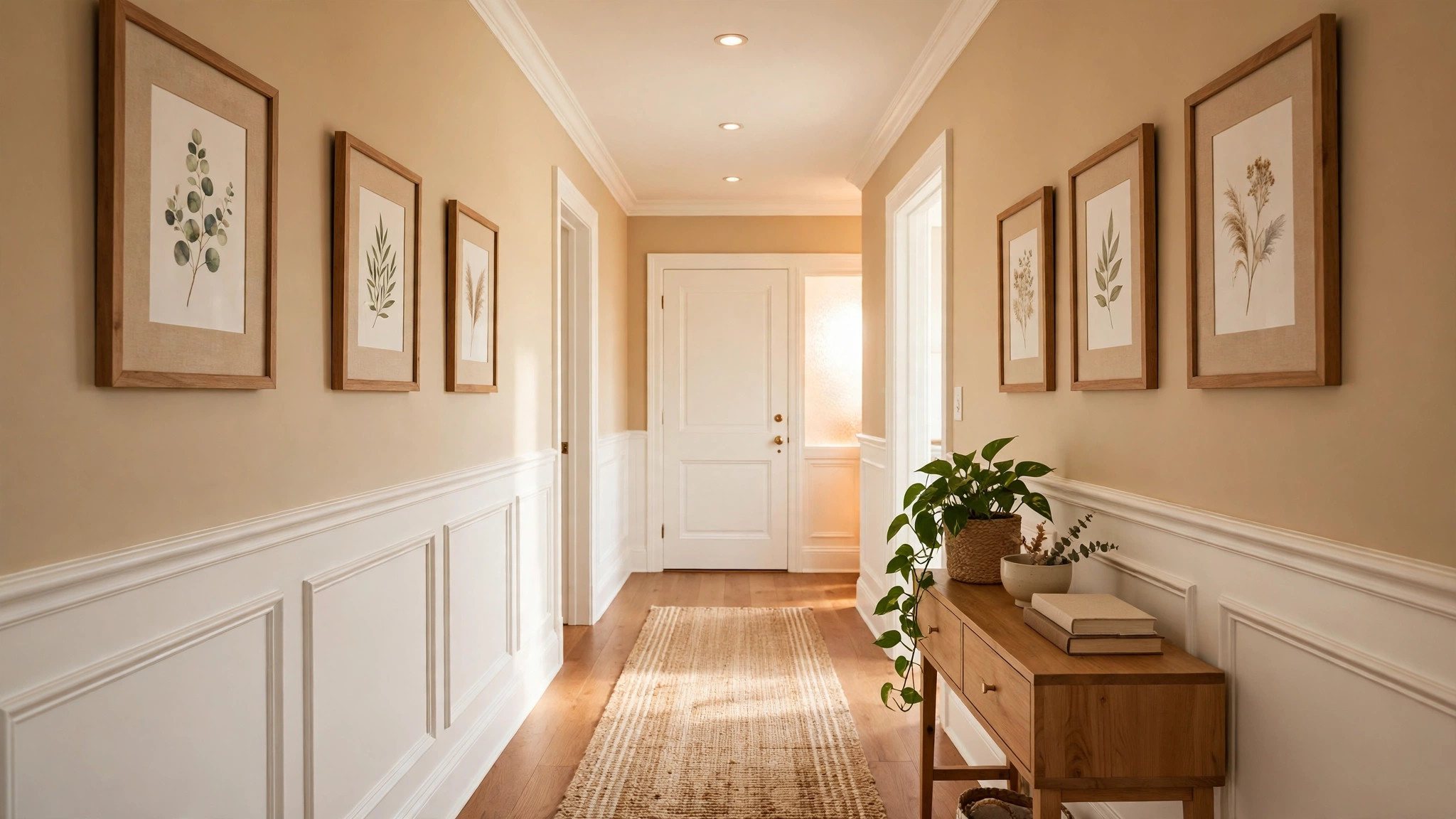

Hallways are the trickiest rooms in the house to paint. Most get little or no natural light, they are viewed in passing rather than at rest, and they touch nearly every other room, so the color has to get along with all of them. The right hallway paint ideas solve all three problems at once: they bounce the light you do have, they feel calm at a glance, and they form a neutral bridge between bolder rooms.
This guide walks through proven paint colors for hallways, the classic white hallway done properly, a gray hallway that feels fresh instead of cold, and the practical details, light, sheen, and trim, that decide whether a color succeeds in a passage. Once the walls are sorted, our hallway decor guide covers the runners, art, and lighting that complete the space.
Hallway Paint Colors That Brighten Dark Spaces
For a hallway with no windows, color choice is really light management. Paint has a light reflectance value, or LRV, printed on the swatch or the manufacturer’s site; the higher the number, the more light the color bounces. In a dark hall, look for colors with an LRV roughly between 55 and 75: light enough to lift the space, deep enough to hide scuffs and avoid a stark, chalky look.
Reliable brightening directions:
- Warm whites and creams that borrow warmth from artificial light instead of turning blue.
- Pale greiges (gray-beiges) that read neutral next to both warm and cool adjoining rooms.
- Soft sage or pale blue-green in small doses, which feels fresh in warm bulb light.
- Pale warm gray, the workhorse of hallways, paired with bright white trim for definition.
Famous, widely available colors that behave well in halls include Benjamin Moore White Dove (OC-17), a soft warm white, and Sherwin-Williams Alabaster (SW 7008), a creamy white with a gentle warmth. Always sample on the wall and check the color at night under your actual bulbs, since hallway color is mostly experienced in artificial light. Finish matters too, covered in the light section below.
Hallway Colors for Warmth: Greige, Cream, and Soft Neutrals
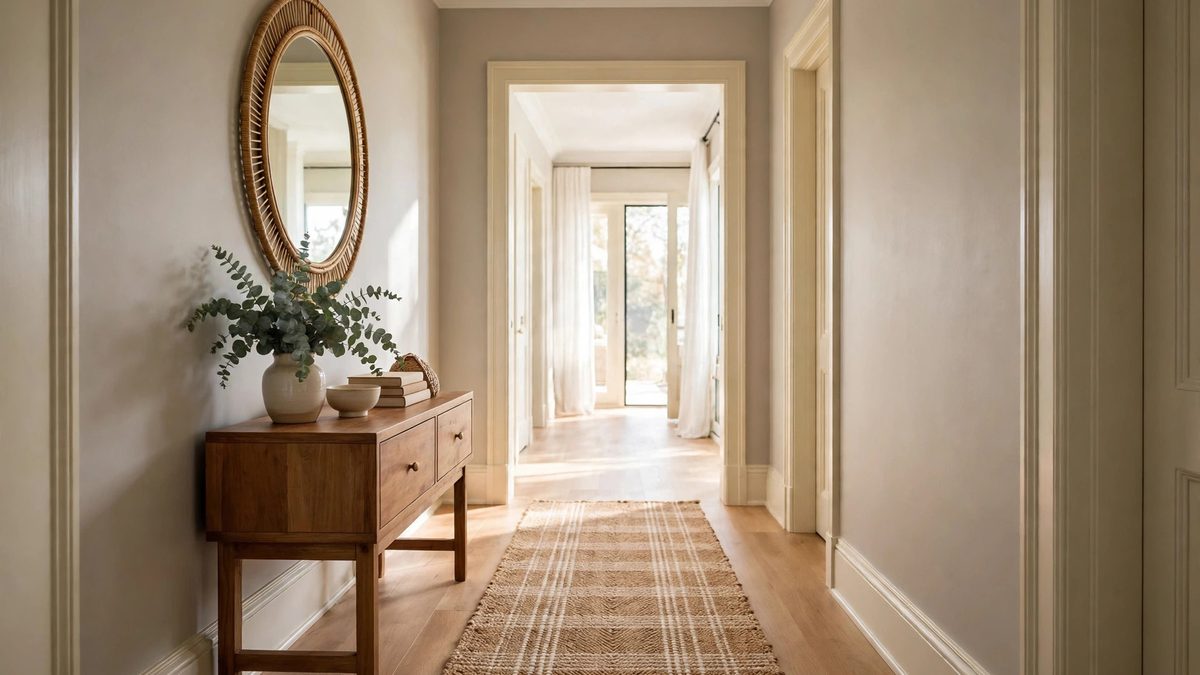
Some hallways do not need brightening so much as warming: north-facing passages, halls in cool climates, and entries that feel stark. Warm neutrals fix the temperature without going dark. Greige is the hallway hero here. Benjamin Moore Revere Pewter (HC-172) is a famous light gray with warm undertones that shifts gracefully between daylight and lamplight, and its lighter sibling, Edgecomb Gray (HC-173), suits halls with less light.
Creamy tones work where the house already leans traditional: warm cream walls with white trim and a natural-fiber runner feel classic and welcoming. If adjoining rooms carry strong colors, a warm neutral hall lets them be the stars while the passage stays connected. Carry the warmth through with warm-white bulbs and wood tones in frames and any console furniture. Our guide to bedroom paint ideas uses the same undertone-matching logic if you are coordinating a whole floor at once.
The Classic White Hallway, Done Right
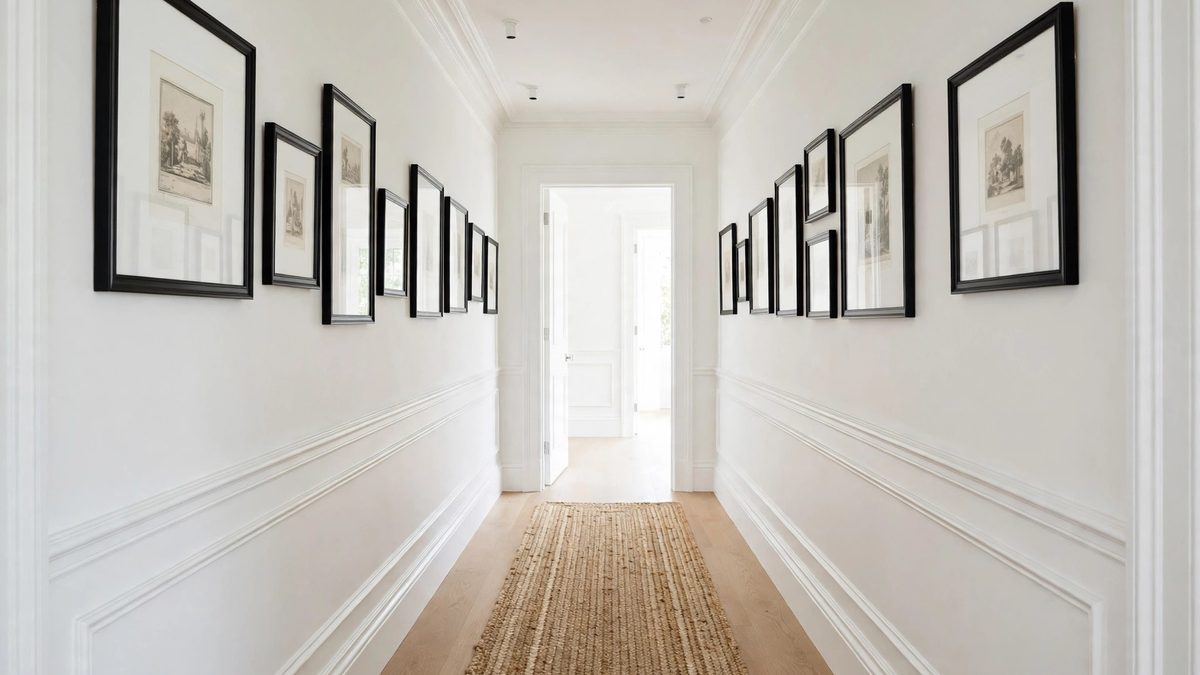
A white hallway is the timeless choice, and also the easiest to get subtly wrong. Pure bright whites can turn blue or glaring under warm bulbs and show every scuff, which is why the soft, slightly warm shades of white are the professional favorites for passages.
How to make white work in a hall:
- Choose a warm white. Benjamin Moore Simply White (OC-117) and White Dove (OC-17) are beloved because they stay clean without going cold or yellow.
- Use contrast on purpose. White walls need a partner: a colored runner, wood frames, black hardware, or a painted end wall keeps the hall from feeling like a gallery corridor in a rental.
- Pick a washable finish. Eggshell or satin scrubs clean far better than flat, which matters where hands, bags, and paws brush the walls daily.
- Keep trim the same white, one sheen up. Satin or semi-gloss on trim against eggshell walls gives the subtle architecture that makes plain white feel designed.
White also future-proofs the hall: any rug, art, or adjoining-room color will work against it, so it is the safest choice when the rest of the house is still evolving.
A Gray Hallway That Feels Fresh, Not Cold
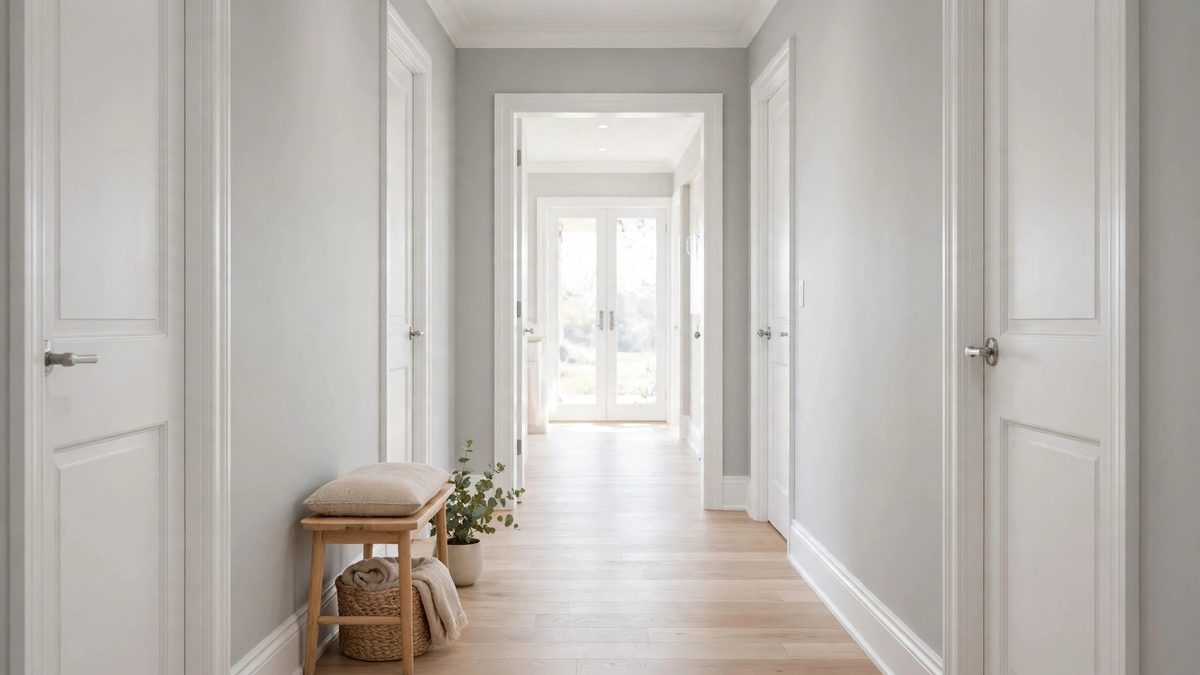
Gray had a long run as the default neutral, and in hallways the warm grays still earn their place. The secret is undertone. Blue-gray and purple-gray colors turn chilly in low light; warm grays with a beige or green base stay friendly.
Two of the most proven hallway grays in the US are Sherwin-Williams Agreeable Gray (SW 7029), a warm greige-gray light enough for most halls, and Sherwin-Williams Repose Gray (SW 7015), a touch cooler and deeper, better in halls that get some daylight. Style a gray hallway to keep it fresh:
- Bright white trim and ceiling to sharpen the contrast.
- Warm wood in the runner, frames, or a console to offset the coolness.
- Warm-white bulbs, since cool bulbs push gray toward blue.
- One living accent, a plant at the end of the hall or a bowl on the console, in a clear color like green or rust.
If you love gray but your hall is truly dark, step one shade lighter than your instinct. Colors read deeper on four walls in low light than they do on a swatch, and the lighter version usually lands where you hoped the darker one would.
How Light Changes Hallway Paint (and How to Test It)
Light is the invisible ingredient in every hallway color. A few practical rules:
- Bulb temperature changes everything. Warm bulbs (2700K) add yellow, daylight bulbs (4000K and up) add blue. Choose your bulbs first, then judge paint under them.
- North-facing and windowless halls receive only cool, indirect light, so colors look grayer; compensate with warmer paint than you think you need.
- Sheen shifts perception. Flat paint absorbs light and looks deeper and softer; satin and eggshell reflect a little and look lighter, plus they wipe clean, the practical pick for a passage.
- Test big. Paint two coats on a large poster board or directly on two walls, and live with it for a day and a night before committing. Hallway color is experienced in motion and mixed light, and small chips lie.
If the hall connects rooms of very different colors, sample the hallway color next to each doorway to be sure it shakes hands with both neighbors.
Two-Tone and Trim Ideas That Add Architecture
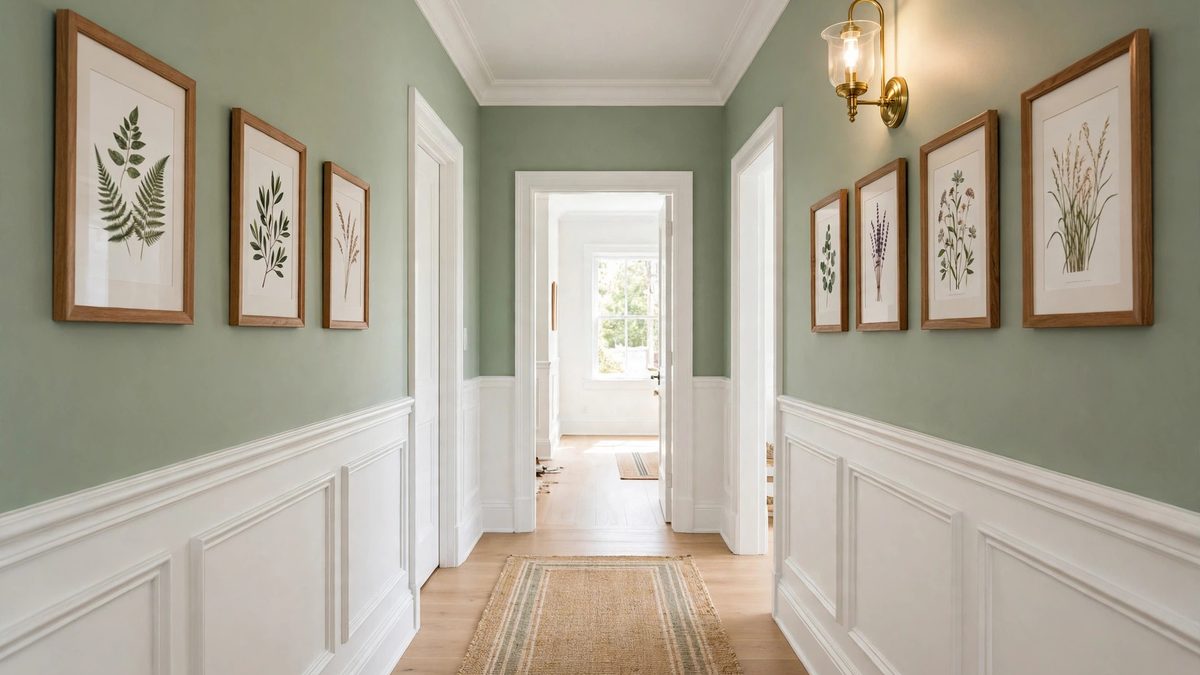
A hallway’s long, plain walls are a perfect canvas for two-tone treatments that fake architectural detail. The classic is wainscoting or board and batten on the lower wall, painted in the trim color or a deeper shade, with a lighter color above. Chair rail height is typically around 32 to 36 inches from the floor. The lower section takes the scuffs, looks tailored, and lets you use a bolder color above or below than you would dare on all four walls.
Other two-tone moves: paint the end wall a deeper version of the hallway color to shorten a long hall visually; paint doors and trim in a soft contrast color, like warm white against greige walls; or carry one color over walls, trim, and doors for a calm, modern envelope, then let the runner and art supply the contrast. For more ways to build on freshly painted walls, see our hallway wall decor ideas.
Hallway Paint Mistakes to Avoid
- Choosing from the chip alone. Hallway light is mostly artificial and colors read deeper in enclosed spaces. Always test large samples at day and night.
- Going too dark in a windowless hall. A moody color can work in a short entry with great lighting, but a long dark tunnel of it rarely feels welcoming.
- Flat paint in a high-traffic passage. It scuffs and cannot be scrubbed. Eggshell or satin is the practical hallway finish.
- Ignoring undertones next to adjoining rooms. A gray that clashes with the living room’s warm beige will bother you every single pass. Compare samples at the doorways.
- Forgetting the ceiling. A dingy ceiling drags the whole hall down. Bright white ceiling paint is the cheapest lift in the project.
Frequently Asked Questions
What is the best paint color for a hallway with no windows?
A warm white or pale greige with a light reflectance value around 60 to 75 is the safest bet. Benjamin Moore White Dove and Sherwin-Williams Agreeable Gray are popular because they bounce limited light without turning cold, and both pair with almost any adjoining room color.
What sheen should hallway paint be?
Eggshell or satin. Hallways take constant contact from hands, bags, and pets, and these sheens wipe clean without the glare of semi-gloss on walls. Use satin or semi-gloss on trim and doors, which take the hardest wear.
Should hallway walls match the living room?
They do not have to match, but they should relate. A hallway one or two shades lighter than the living room, or a neutral that shares its undertone, creates a smooth transition. When in doubt, use the same color at a lighter strength, a trick paint stores can mix for you.
How do I make a long hallway look shorter with paint?
Paint the far end wall a deeper shade of the hallway color, or a deliberate accent, to pull it visually closer. A two-tone treatment with wainscoting along the length also breaks up the tunnel effect, as does a runner with a strong border pattern.
How often should a hallway be repainted?
High-traffic hallways typically need fresh paint every 3 to 5 years, depending on wear and whether the finish was washable. Touching up scuffs yearly with the same paint, kept labeled in a sealed jar, stretches the interval considerably.
Conclusion
Hallway paint succeeds when it respects light, traffic, and neighbors. Choose a warm-leaning color with enough reflectance to lift the space, test it under your own bulbs at night, use a washable eggshell or satin finish, and let trim and two-tone details supply the architecture. Get the walls right and every runner, frame, and fixture you add afterward will look twice as good.
