
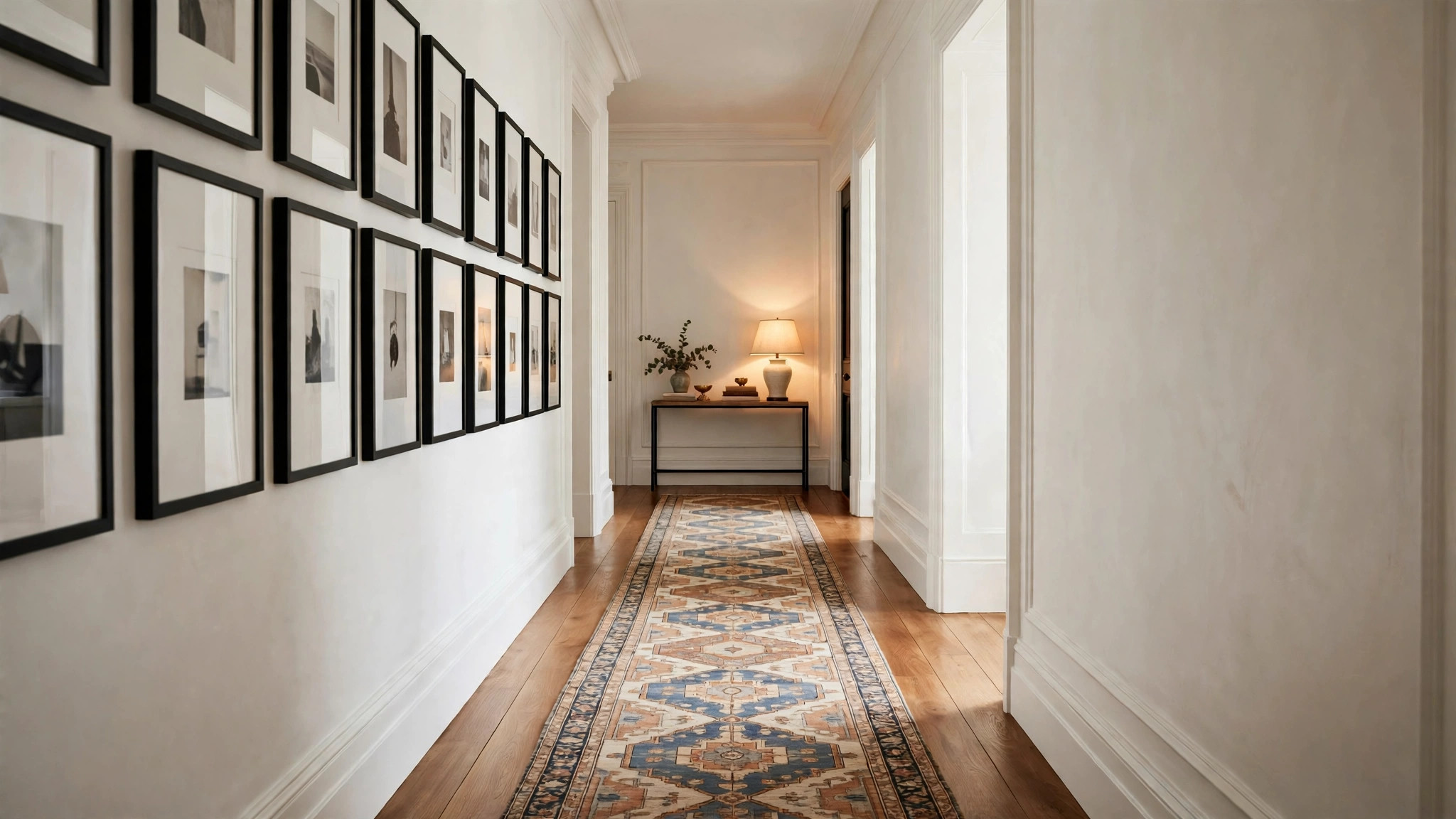

Hallways are the most walked-through and least decorated spaces in most homes. We pass through them dozens of times a day, yet they often end up as bare tunnels with a ceiling light and nothing to look at. Good corridor decoration ideas change that completely. With a runner, some considered wall decor, and better lighting, a hallway stops being leftover space and starts feeling like a designed part of the home.
The word itself hints at the opportunity: an elongated entrance or passage, what architecture calls a hall or corridor, connects every room, so its style sets the tone for the whole house. This guide covers the elements that work in almost any hall, then tackles long, small, and modern hallways specifically, and finishes with the often-forgotten end of the hallway, which deserves a destination of its own.
Hallway Decorations That Make a Plain Corridor Feel Finished
Start with the core layers that suit nearly every hallway. First, a runner. Most residential hallways are 3 to 4 feet wide, and a runner of 2 to 3 feet wide leaves a border of floor showing on each side, which looks tailored rather than carpeted wall to wall. Lengths of 6 to 14 feet cover most halls; our standard rug sizes guide explains how to measure so the runner stops short of doorways and end walls.
Second, treat the walls as a gallery in progress. A run of matching frames, a picture ledge, or one oversized piece every few feet gives the eye places to land. Third, fix the lighting: a hallway lit by one harsh ceiling bulb feels institutional, while a series of flush mounts, sconces, or a pendant or two feels like a boutique hotel. Finally, add one functional piece if width allows: a narrow console, a bench with baskets, or a mirror that checks your reflection on the way out. Those four layers, floor, walls, light, and one useful piece, finish almost any corridor.
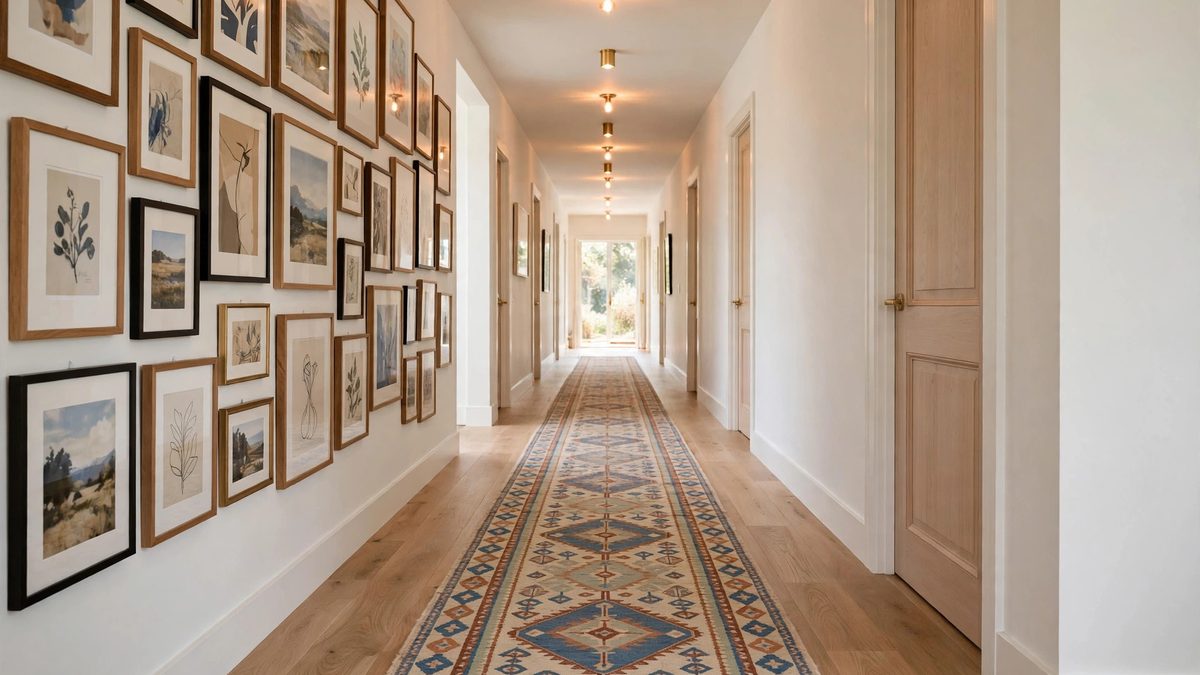
Long Hallway Decor Ideas That Break Up the Tunnel Effect
Long hallways have one main problem: they read as a single endless shot, which makes them feel narrower and more boring than they are. The fix is rhythm, breaking the length into a series of moments.
- Segment the floor. Use two shorter runners with a gap between them instead of one endless strip, or choose a runner with a border pattern that creates natural pauses. Standard runner sizing guidance suggests leaving a few inches of floor at each end, which also helps a long hall feel measured rather than stretched.
- Repeat a motif. The same frame style, sconce, or paint treatment repeated three or four times creates a beat the eye can follow.
- Create a midpoint moment. A console with a lamp, a bench, or a wider art piece halfway down gives the corridor a middle, not just a start and finish.
- Use color blocking. Paint the far end wall a deeper shade, or run wainscoting along the length, to shorten the visual distance.
If the hallway also has doors on both sides, keep door colors consistent with the trim so the rhythm stays calm rather than choppy.
How to Decorate a Long Hallway, Step by Step
If you want a simple order of operations, this sequence works for most long halls:
- Measure and note the obstacles. Record the length and width, and mark radiators, returns, and doors that swing into the hall.
- Choose the runner first. Its colors become the palette for art and paint. Add a rug pad; runners in busy halls shift and curl without one.
- Plan the lighting. Replace the single fixture with two or three flush mounts or semi-flush fixtures spaced evenly, on warm-white bulbs and, if possible, a dimmer.
- Hang the wall decor. A gallery run on one wall and a mirror or single large piece on the other keeps balance without crowding. Center groupings at about 57 inches.
- Add the end treatment (covered below) and one functional piece if the width allows at least a comfortable walking path.
- Style lightly. A small stack of books or a plant on the console, nothing that narrows the passage or invites clutter.
Working in this order prevents the classic mistake of buying art before you know the palette, or a runner that fights the paint you chose later.
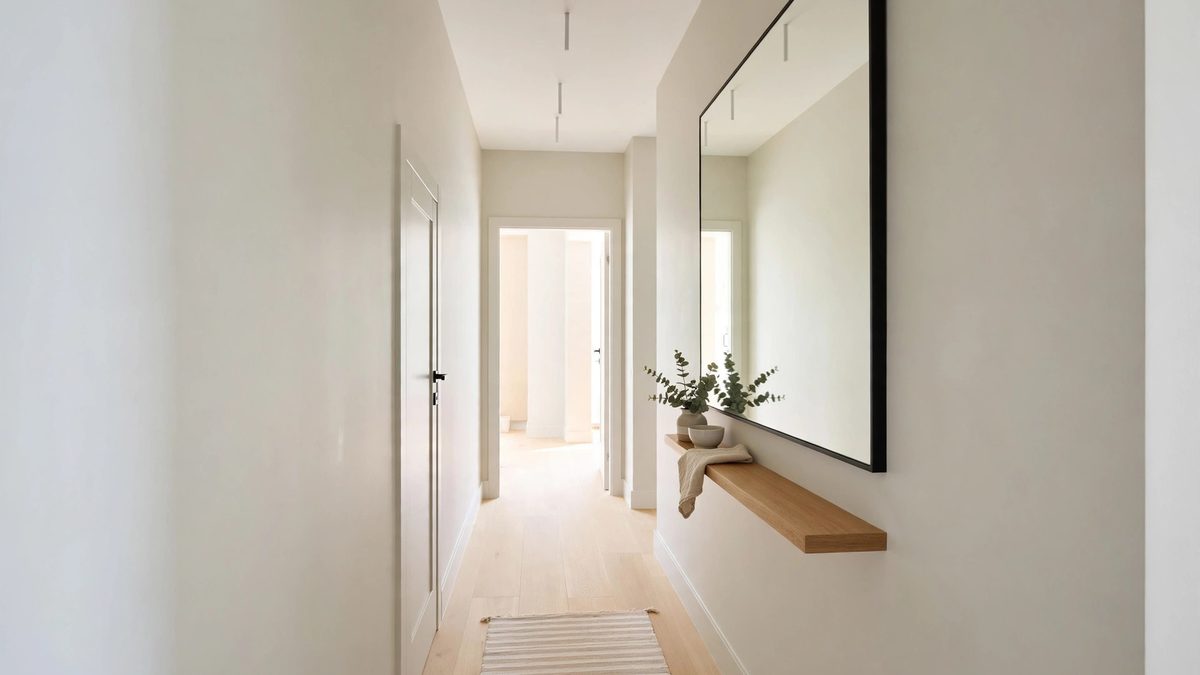
Small Hallway Ideas for Narrow Spaces
A small hallway, whether short, narrow, or both, needs the opposite discipline: fewer, lighter moves. Keep the walls a light, warm neutral and let one element, usually the runner or a mirror, be the personality. Mirrors earn their keep in small halls by bouncing light from adjacent rooms and doubling the sense of depth; a long mirror at one end can visually extend the space.
Choose shallow solutions everywhere. A picture ledge 3 to 4 inches deep displays art and photos without a single nail per frame and lets you rotate pieces freely. Wall hooks replace a coat tree. A runner at the narrower end of standard widths, around 2 feet, keeps the floor border visible so the hall does not feel carpeted shut. If there is a door at the end, painting it the wall color helps it disappear, while painting it a deliberate accent makes it a focal point; both are better than ignoring it. Our gallery wall layout guide has ledge and grid arrangements sized for tight walls like these.
Contemporary Hallway Ideas With Clean Lines
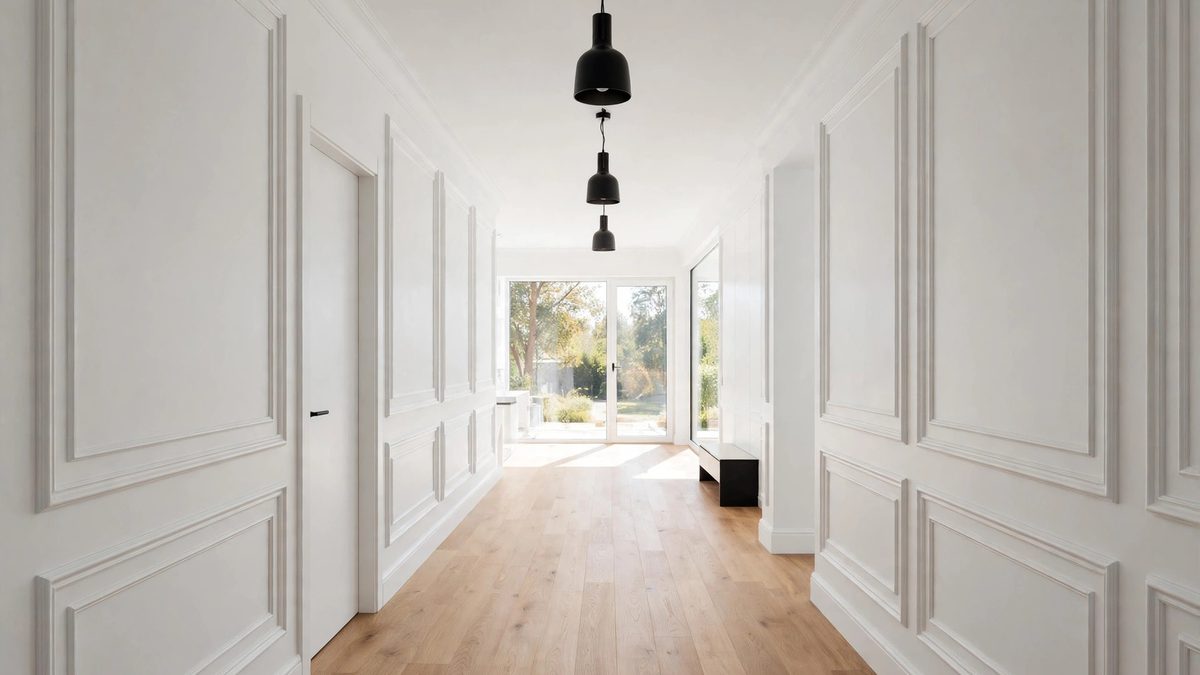
A contemporary hallway leans on restraint: flat or low-profile trim, a limited palette, and decor that reads as architecture rather than objects. Think white or pale warm-gray walls, black or pale wood accents, and one material repeated throughout, such as black metal frames and fixtures from end to end.
Ideas that deliver the look:
- Flush, minimal lighting in a repeated series, or a single linear fixture in a long hall.
- Oversized abstract art in one or two large pieces instead of a gallery of small ones.
- A floating console or bench in pale wood or matte black, kept nearly empty.
- Panel molding painted the same color as the wall, which adds shadow-line texture without pattern.
- A monochrome runner, flat-weave and borderless, or a natural jute texture for warmth.
Contemporary does not have to mean cold. Warm white instead of blue-white paint, one wood element, and warm bulbs keep the clean lines feeling residential. Coordinate the palette with the adjoining rooms using our hallway paint colors guide so the hall feels like a bridge, not a break.
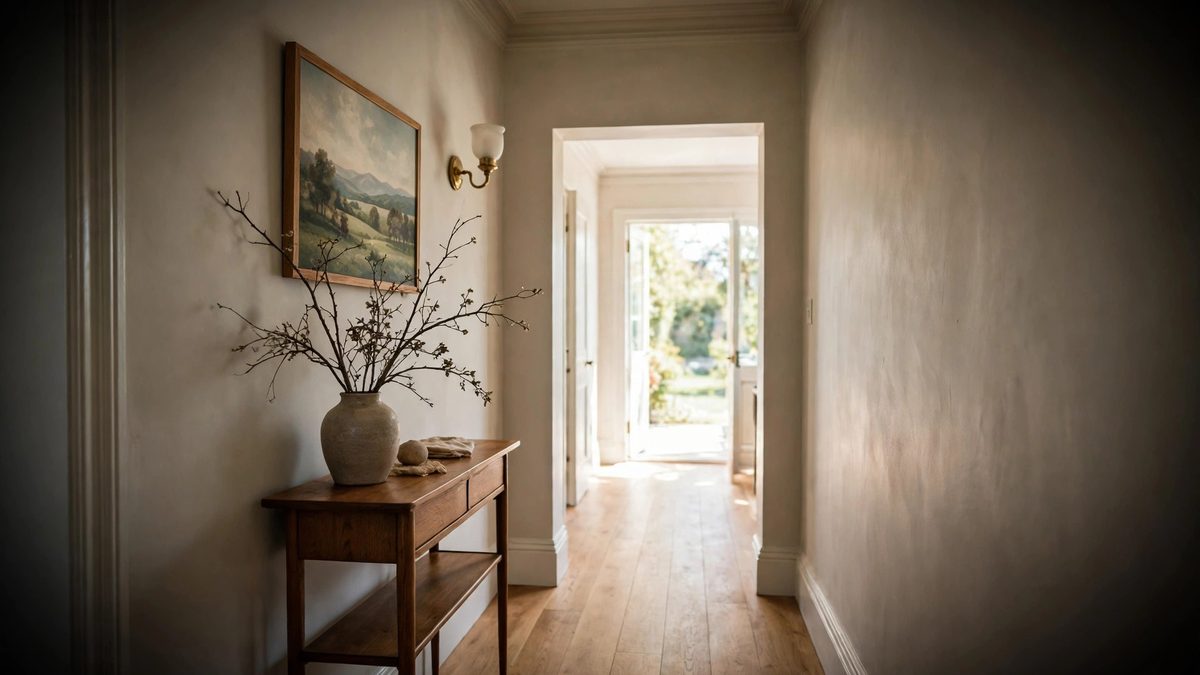
End of Hallway Decor: Give the View a Destination
The end wall is the most-seen and least-used surface in the house: you look straight at it every time you enter the hall. Leaving it blank wastes the best focal point you have. Give it a destination:
- A console table with a lamp and one styled object, if the end is wide enough.
- A single oversized piece of art or a mirror that reflects a window or a pretty room back at you.
- A statement paint color or a panel of wallpaper on that wall only.
- A bench with cushions and a hook rail, turning the end into a mini drop zone.
- A tall plant or a floor vase with branches in the corner beside the end wall.
If the end of the hall is a door, treat the door as the destination instead: paint it a deliberate color, upgrade the hardware, and hang a small wreath or sign. You will be surprised how much more intentional the whole corridor feels once the view lands somewhere.
Hallway Decor Mistakes to Avoid
- Skipping the rug pad. Runners slide, bunch, and wear out faster without one, and in a high-traffic hall that is a tripping hazard.
- One lonely ceiling light. It flattens everything and leaves the ends of the hall in shadow. Space fixtures along the length.
- Art hung at random heights. Pieces drifting between door-top height and eye level look accidental. Keep centers consistent around 57 inches.
- Furniture that narrows the path. If you cannot walk the hall carrying a laundry basket, the console is too deep.
- Treating the hall as storage overflow. Ladders, boxes, and spare chairs parked in the corridor undo every decorative effort.
Frequently Asked Questions
How wide should a hallway runner be?
Leave about 4 to 6 inches of visible floor on each side of the runner. In a typical 3-foot-wide hallway, that means a runner around 24 inches wide; in a 4-foot hallway, 30 to 36 inches works well. Standard runner widths are 2 to 3 feet, in lengths from about 6 to 14 feet.
What do you put at the end of a hallway?
Give the end wall a focal point: a console with a lamp, one oversized piece of art, a mirror, a bold paint color, or a bench with hooks. If a door sits at the end, paint and style the door itself as the destination.
How do you decorate a hallway with no natural light?
Lean on lighting and reflection. Use multiple warm-white fixtures spaced along the ceiling, a mirror to borrow light from adjoining rooms, light warm paint colors with a satin or eggshell sheen that reflects a little light, and a lighter-toned runner.
How many pictures should hang in a hallway?
There is no fixed number, but rhythm matters more than count. A gallery of 5 to 9 medium frames on one wall, or 2 to 3 large pieces, usually looks composed. Keep spacing even and centers aligned at about 57 inches so the run feels deliberate.
Can you put furniture in a hallway?
Yes, if the width allows. A console or bench 10 to 14 inches deep works in wider halls, especially at the end or against a long wall. The rule is traffic first: you should still be able to carry furniture and laundry through without turning sideways.
Conclusion
A hallway becomes a feature the moment you treat it like a room: a runner with the right proportions, walls with rhythm, lighting in layers, and a proper focal point where the corridor ends. Start with the floor and the light, adapt the moves to your hallway’s size and style, and the most ignored space in your home may become one of the most satisfying to walk through.
