
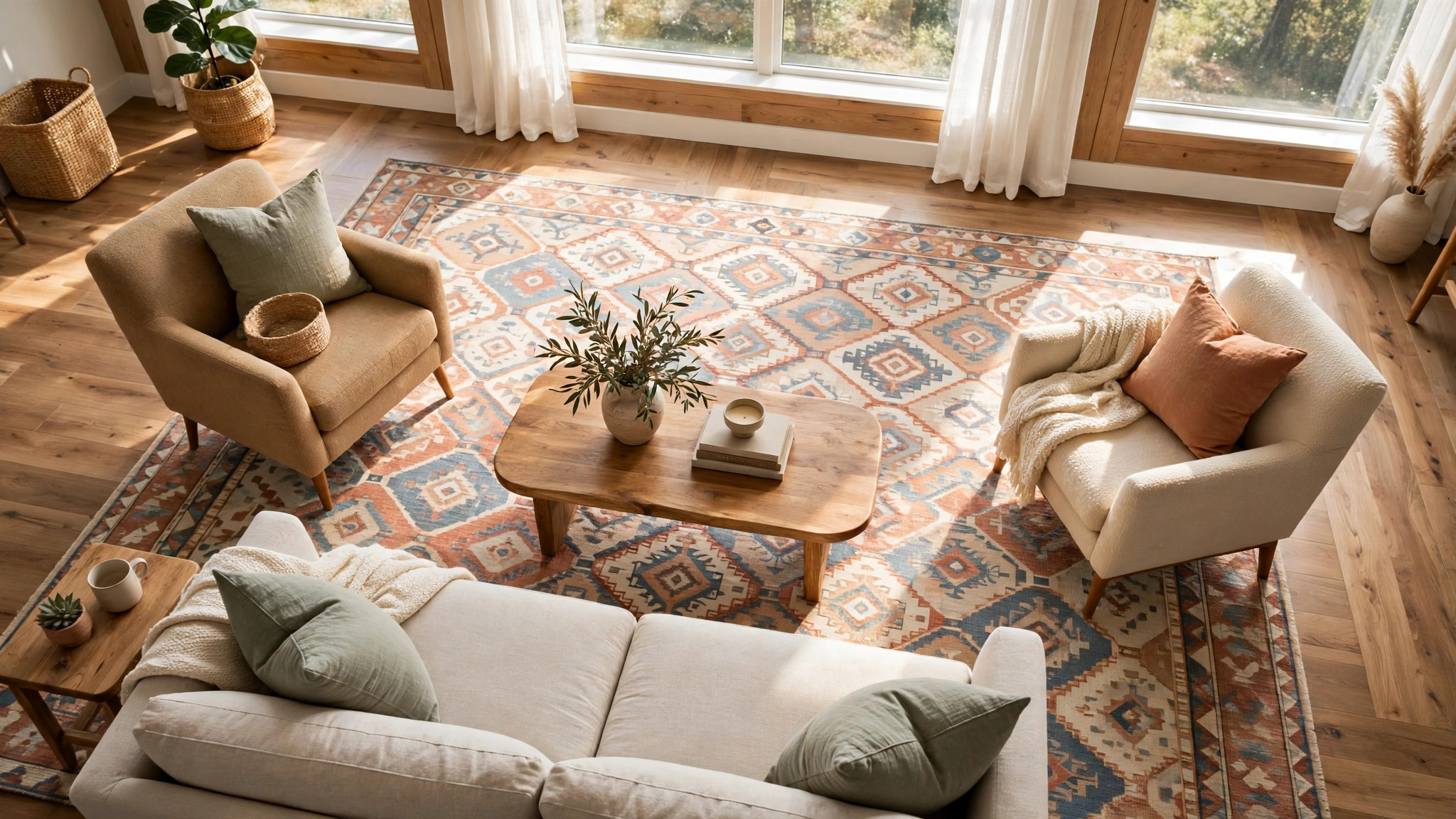

Ask a decorator for the single most common living room mistake and many will give the same answer: a rug that is too small. It is an easy error to make, because rug sizing is not intuitive. Standard rug sizes follow a set ladder, and each room has placement rules that decide which rung of the ladder you need. Pick by those rules and the rug quietly makes the whole room look pulled together.
This guide lays out the standard sizes, what each one is really for, and the layout rules for living rooms, dining rooms, and bedrooms. It also covers how to measure before you order, because the five minutes with a tape measure are what separate a rug that anchors the room from one that floats in the middle of it.
Area Rug Sizes at a Glance: The Standard Chart
Manufacturers build to a shared set of dimensions. These standard area rug sizes are the ones you will find in stock almost everywhere:
| Rug size | Best for |
|---|---|
| 2 x 3 ft | Doorways, in front of a sink, small accents |
| 3 x 5 ft | Entryways, beside a bed, kitchen work zones |
| 4 x 6 ft | Small seating nooks, under a desk, layered looks |
| 5 x 7 or 5 x 8 ft | Small living rooms, apartments, nurseries |
| 6 x 9 ft | Medium living rooms, under a queen bed (partial) |
| 8 x 10 ft | The standard living room size; dining for six |
| 9 x 12 ft | Large living rooms, king bedrooms, open plans |
| 10 x 14 ft | Great rooms and very large seating groups |
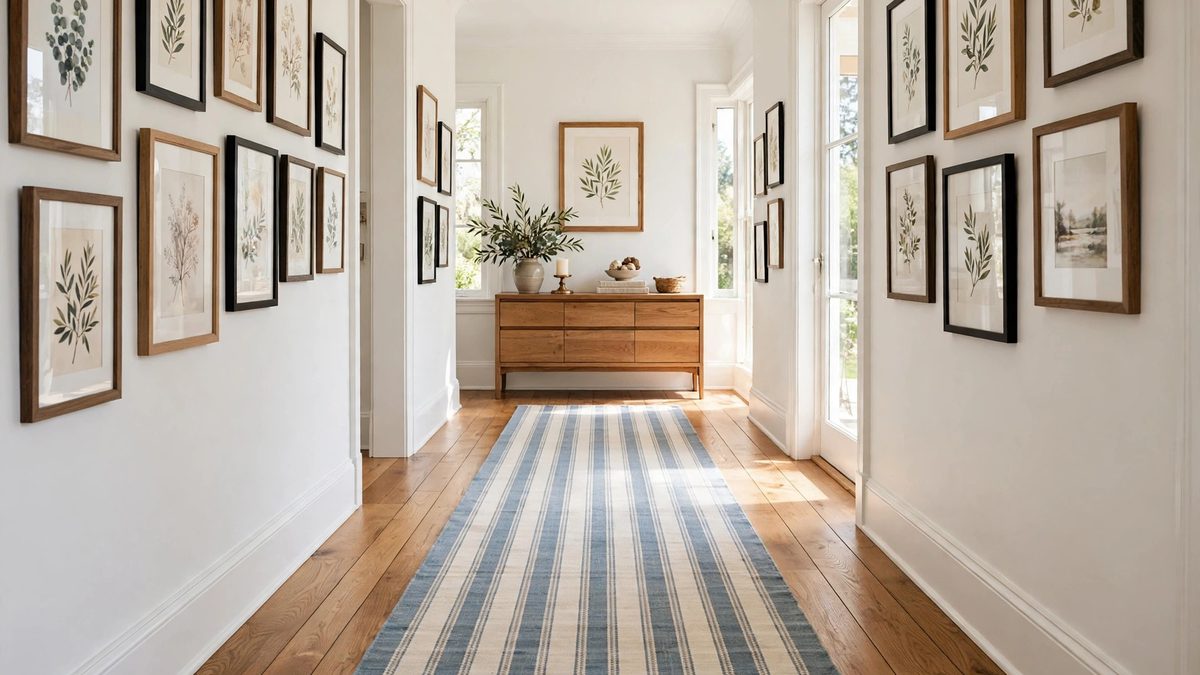
| Runner: 2 to 3 ft wide x 6 to 12 ft long | Hallways, kitchens, beside beds |
Two practical notes. First, listed sizes are approximate: a rug sold as 8 x 10 may measure a few inches off in either direction, and hand-made rugs vary the most. Second, when your room falls between two sizes, designers almost always advise going up, not down. A slightly generous rug reads as intentional; a slightly small one reads as a mistake. For a visual chart of how each size sits in a room, the size guide from Jaipur Rugs is a handy reference.
Rug Sizes for Living Room Layouts That Work
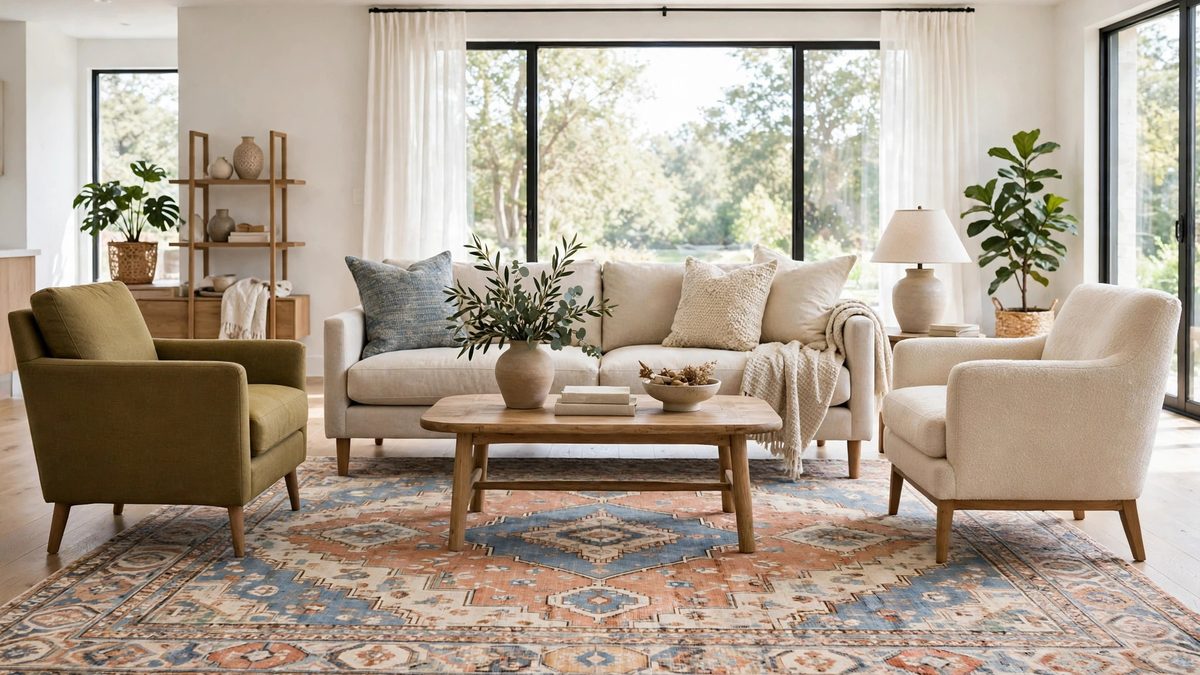
The living room is where rug sizes for living room furniture are won or lost, because the rug’s real job is to unite the seating group. There are three accepted layouts:
- All legs on. Every seat’s four legs sit on the rug. This is the most polished look and suits large rooms, usually with a 9 x 12 or larger.
- Front legs on. The front legs of the sofa and chairs rest on the rug and the back legs sit off it. This is the most popular arrangement and works beautifully with an 8 x 10 in a medium room.
- Coffee table only. Just the coffee table sits on the rug in a very compact seating group. This is the fallback for small rooms and 5 x 8 rugs, and it works only when the furniture is pulled close.
Whichever layout you choose, leave a border of bare floor around the rug, roughly 18 to 24 inches in a typical room, less in a small one. The rug should also sit centered on the seating, not on the room, if the two differ. If you are planning the whole seating zone from scratch, our living room design ideas walk through how rug, sofa, and tables relate.
Dining Room and Bedroom Rug Rules
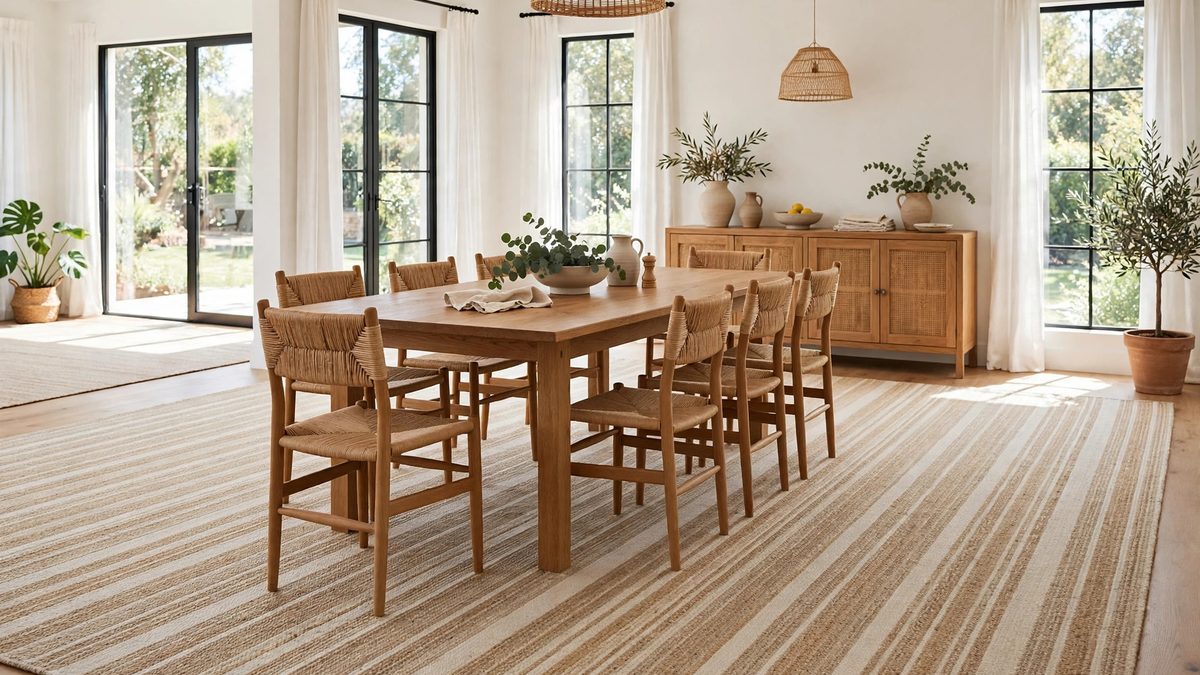
Dining rooms follow one clear rule: the rug should extend about 24 inches beyond the tabletop on every side, so chairs stay on the rug even when pulled out and occupied. A table for six, typically around 36 by 72 inches, therefore wants an 8 x 10 rug. A table for eight usually needs a 9 x 12. Skipping this rule is why dining rugs so often look skimpy and why chair legs catch on the rug edge mid-meal.
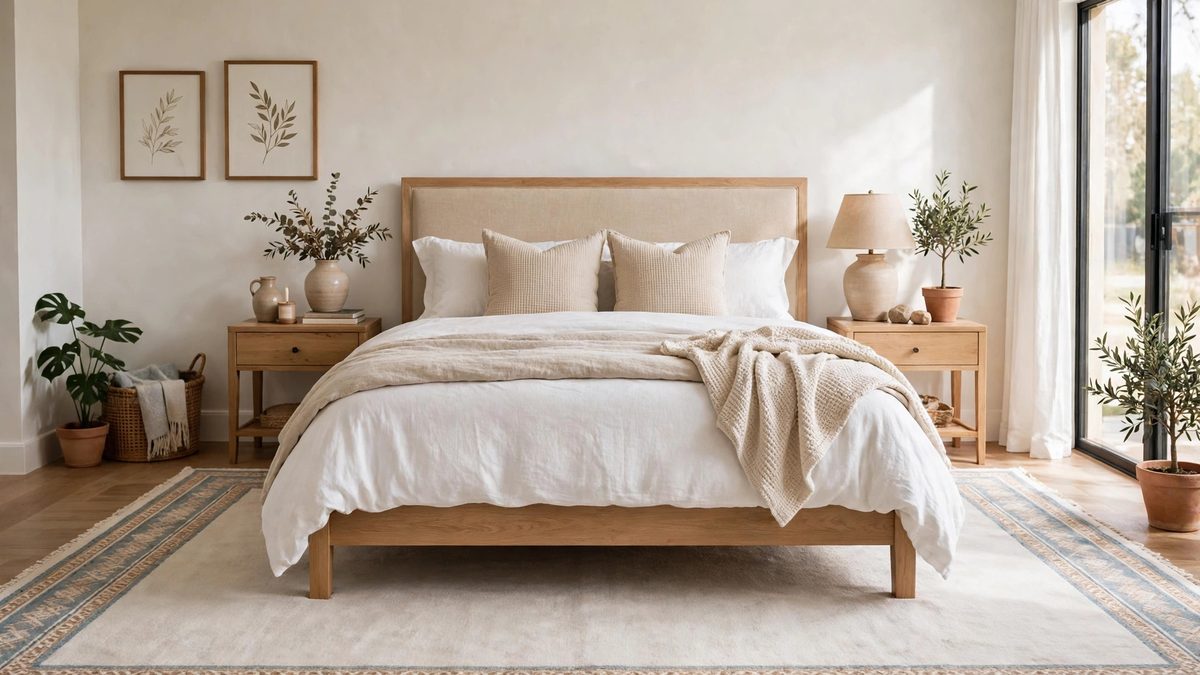
Bedrooms are sized by how much soft floor you want to step onto. For a queen bed, an 8 x 10 placed under the lower two-thirds of the bed, extending out on both sides and at the foot, is the comfortable standard; a 9 x 12 gives a more generous border. King beds generally start at 9 x 12. Two runners, one on each side of the bed, are a smart budget alternative in narrow rooms.
In small bedrooms, resist the urge to shrink the rug to whatever fits the leftover floor. A too-small bed rug disappears entirely. Our small room decor ideas include more tricks for making compact rooms feel complete rather than cramped.
How to Measure Your Room Before You Order
-
Measure the room wall to wall, and note doors, vents, and any furniture that will not move.
-
Tape the rug outline on the floor with painter’s tape at the size you are considering. Live with it for a day and walk around it.
-
Check the furniture fit. Confirm the front legs (or all legs) of your seating land where your chosen layout requires.
-
Check door clearance. Plush piles can run over 1/2 inch thick; a rug plus pad needs roughly 3/4 inch of clearance under a swinging door.
-
Plan the pad. A rug pad cut about 1 inch smaller than the rug on every side keeps the rug flat, quiet, and safe on hard floors, and it adds years to the rug’s life.
Remember pile height while you measure: low pile is under about 1/4 inch, medium pile runs 1/4 to 1/2 inch, and high or plush pile is above that. High-traffic areas and dining chairs are happier with low pile; bedrooms forgive plush. If you love a layered look, a larger flat-weave rug under a smaller patterned one is forgiving on sizes, a trick explored in our layered rugs guide.
Open-plan homes deserve one extra thought. When one large space holds a living zone, a dining zone, and a walkway, a rug under each zone, sized by that zone’s own rules, makes the floor plan legible. Keep a consistent border of bare floor between rugs, and let the rugs share a color family so the zones feel related rather than chopped up. Undersizing here is the classic error: three small rugs scattered across one big room read as clutter, while two properly sized ones read as design.
Rug Sizing Mistakes to Avoid
- The postage stamp. A 5 x 7 floating in a big room with no furniture touching it fragments the space.
- Centering on the room instead of the furniture. The rug belongs to the seating group, wherever that group sits.
- Forgetting the pulled-out chair test in dining rooms, which is exactly when undersized rugs get exposed.
- Skipping the pad. Rugs creep, bunch, and wear out faster without one, and hard floors get scratched.
- Matching the rug to the sofa color exactly. Contrast grounds a room; a rug that disappears into the furniture flattens it.
Frequently Asked Questions
What is the most common standard rug size?
The 8 x 10 is the most popular living room rug size in the US, because it fits the average sofa-and-chairs arrangement with the front-legs-on layout. The 5 x 8 and 9 x 12 are the next most common, for smaller and larger rooms respectively.
Should all furniture legs be on the rug?
Not necessarily. All legs on is the most formal look and needs a large rug, but the front-legs-on arrangement is a fully accepted designer standard and often the smarter buy. What matters is that at least the front legs of every seat touch the rug so the group reads as one.
How much floor should show around a rug?
In most rooms, a border of about 18 to 24 inches of bare floor around the rug looks balanced. In small rooms, 8 to 12 inches is fine. Even, consistent borders matter more than the exact number.
What rug size fits under a queen bed?
An 8 x 10 is the comfortable standard for a queen, placed under the lower two-thirds of the bed so it extends on both sides and at the foot. A 9 x 12 offers a more generous border, and an 8 x 10 also works for a king in a pinch, though 9 x 12 suits kings better.
Are rug sizes exact?
Not always. Manufacturing tolerances mean a rug labeled 8 x 10 may measure a few inches larger or smaller, especially if it is handmade. Measure your actual rug on arrival before arranging furniture, and allow a little flexibility in your taped outline.
Conclusion
Rug sizing is a ladder, not a mystery: know the standard sizes, choose by layout rule rather than by leftover floor, and size up when you are between rungs. Front legs on at minimum, 24 inches beyond the dining table, a generous border beside the bed, and a pad underneath. Follow those few numbers, verify them with painter’s tape before you buy, and your rug will do the quiet, essential work of making the whole room feel finished.
