
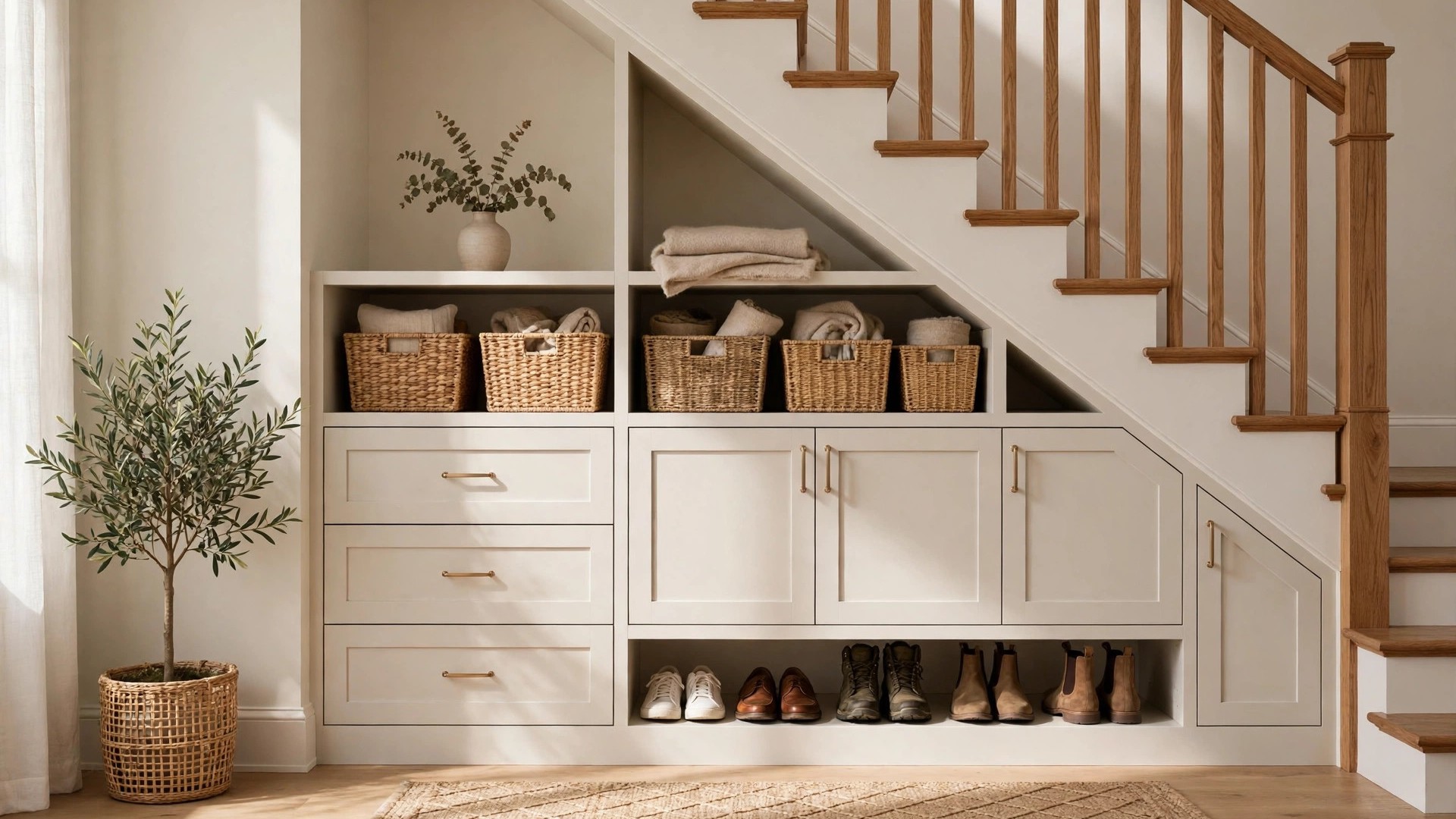

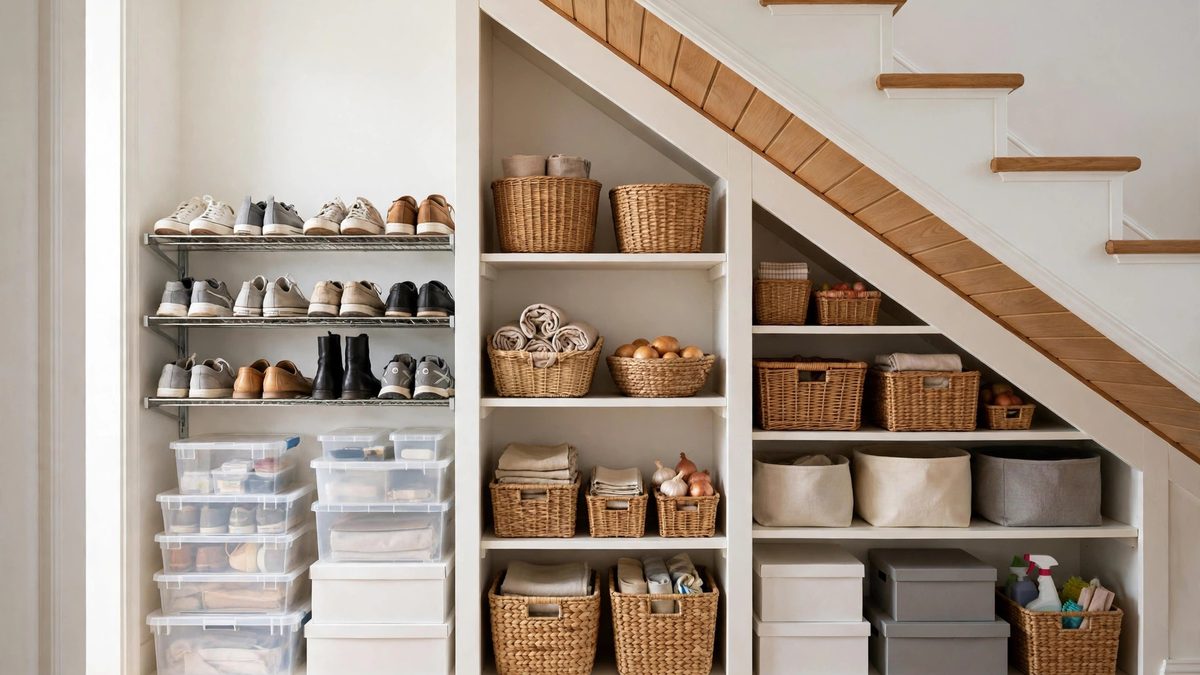
Under almost every staircase sits the most underused square footage in the house: a sloping, awkward void that collects paint cans, off-season clutter, and good intentions. The right under stairs storage ideas turn that dead zone into the hardest-working storage in your home — drawers for shoes, a closet that actually fits coats, a pantry overflow, or even a reading nook or dog den. The space is small, but small storage in the middle of the house, exactly where life happens, is worth more than a big closet in a far corner.
This guide starts with measuring the space honestly, then walks through the main approaches — built-in drawers, closets and cabinets, open shelving, and specialty uses — with the details that make each one work day to day. It also covers the cabinet-door trick for tiny supplies and how to stop the basement from becoming the overflow valve for everything the stairs cannot hold.
Measure First: What Kind of Space Do You Actually Have?
Under-stair spaces come in three rough types. Full-height closets under a staircase’s upper flight can fit a door and standing storage. Half-height spaces suit drawers, cabinets, and cubbies. Low triangular nooks are best for pull-out bins, pet spaces, or a child-scale reading corner. Measure the depth, the width, and the height at several points along the slope — the numbers change every foot or so, and the lowest third of the slope is often only useful for flat or rolling storage.
Also check what is already in there: many under-stair voids hide plumbing cleanouts, electrical panels, or HVAC runs that must stay accessible. Note them before designing anything fixed, and plan access panels or leave those bays open. If your staircase is open to a basement, confirm the space’s ceiling height below and whether the area counts as finished storage for your needs. General background on the below-grade spaces these stairs usually lead to is in the Wikipedia overview of basements.
Built-In Drawers and Pull-Outs: The Space Used to the Inch
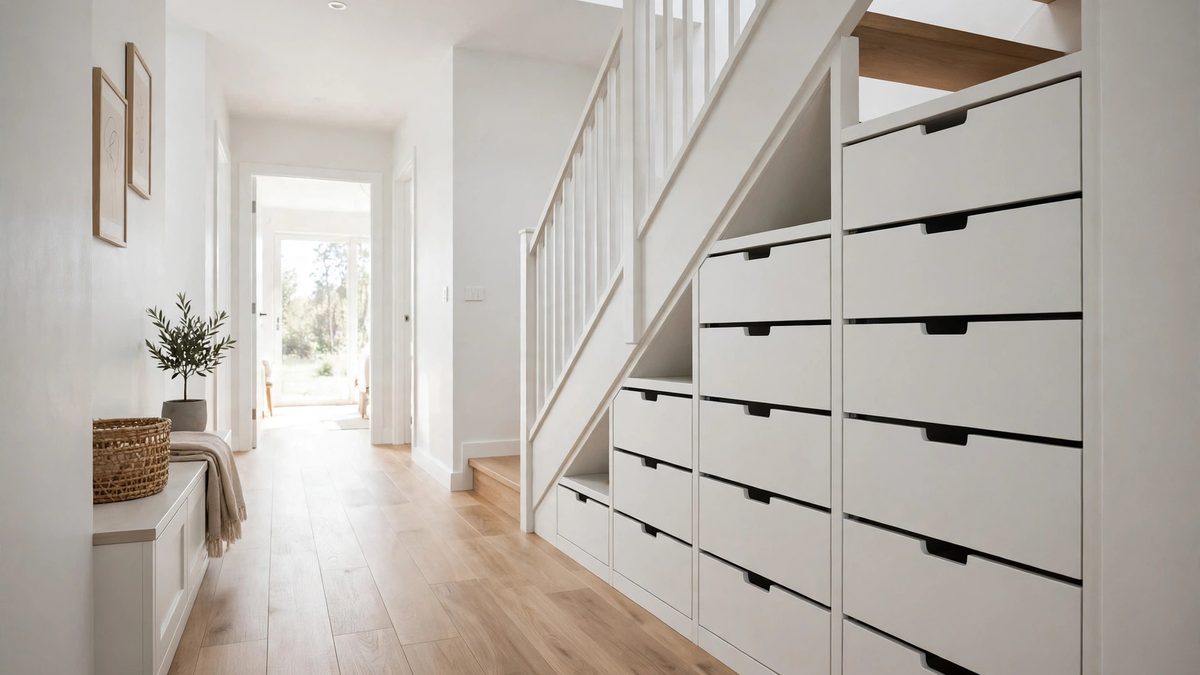
Drawers are the gold standard for under-stair storage because they bring the contents to you — no crawling into the deep, dark point of the triangle. Deep drawers on full-extension slides hold shoes, games, craft supplies, and linens; a bank of two or three drawers in graduated heights follows the slope naturally. Pull-out vertical racks suit the narrow tall section for brooms, wrapping paper, or pantry goods.
Practical points for drawer builds:
- Full-extension slides rated for the load (shoes and books are heavier than they look) make the deepest drawers usable.
- Push-latch or integrated finger pulls beat knobs in a hallway — nothing snags bags and coats as you pass.
- Expect custom or semi-custom pricing: built-in drawers typically cost more per cubic foot than any other option here, which is why many households do drawers for the low section and a closet for the tall section.
If built-ins are beyond the budget, rolling under-stair carts and stackable bins sized to your measurements capture much of the same function for a fraction of the cost — the same measure-first logic we use in how to organize small spaces.
Closets, Cabinets, and Doors That Disappear
A closet under the stairs is the classic answer for coats, the vacuum, and the board-game overflow. Angled or custom doors follow the slope; standard doors work if the opening is on the tall end. Inside, fit the storage to the slope: a hanging rod on the tall wall, shelves stepping down with the ceiling, and bins on the floor for the low corner.
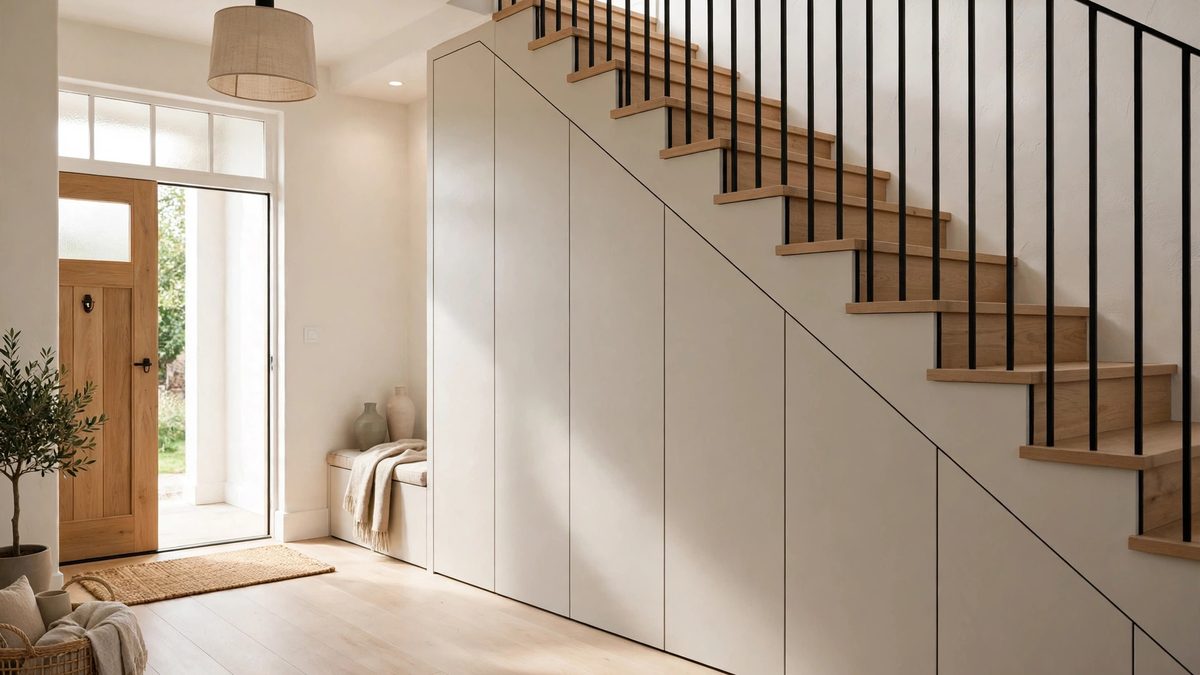
Flat-front cabinets painted the wall color make the storage vanish — an especially good look in living rooms and entryways where the staircase is part of the decor. Add soft-close hinges so doors in a traffic path do not bang. If the staircase sits in the entry, this closet pairs naturally with hooks and a bench outside it, much like the mudroom-style setups in our built in closet guide, where every cubic inch is assigned a job.
Cabinet Door Storage for Small Supplies
Here is the detail most under-stair plans miss: the insides of the doors. Cabinet door storage — slim racks, clear pockets, or shallow shelves mounted on a door’s inner face — turns a flat surface into storage for the small things that otherwise vanish into drawer chaos: batteries, tape, flashlights, pet supplies, gift wrap tools, cleaning cloths.
Door storage works when you respect two limits: keep items slim (about 3 to 4 inches deep maximum) so the door still closes against the interior shelves, and keep the weight modest so hinges do not sag. It is ideal for the under-stair closet’s door and for any cabinet doors in the tall section. Label what lives there — door storage is invisible when closed, which is its charm and its memory test.
Specialty Uses: Pantry, Wine, Reading Nook, Pet Den, Desk
When storage basics are covered elsewhere, the under-stair void can become the room your house is missing:
- Pantry overflow. Near a kitchen, shelves or pull-outs hold bulk goods, small appliances, and the party supplies you use twice a year. Add a door to keep it dust-free.
- Wine storage. The interior, temperature-stable spot suits racking — keep bottles on their sides, away from any heat source.
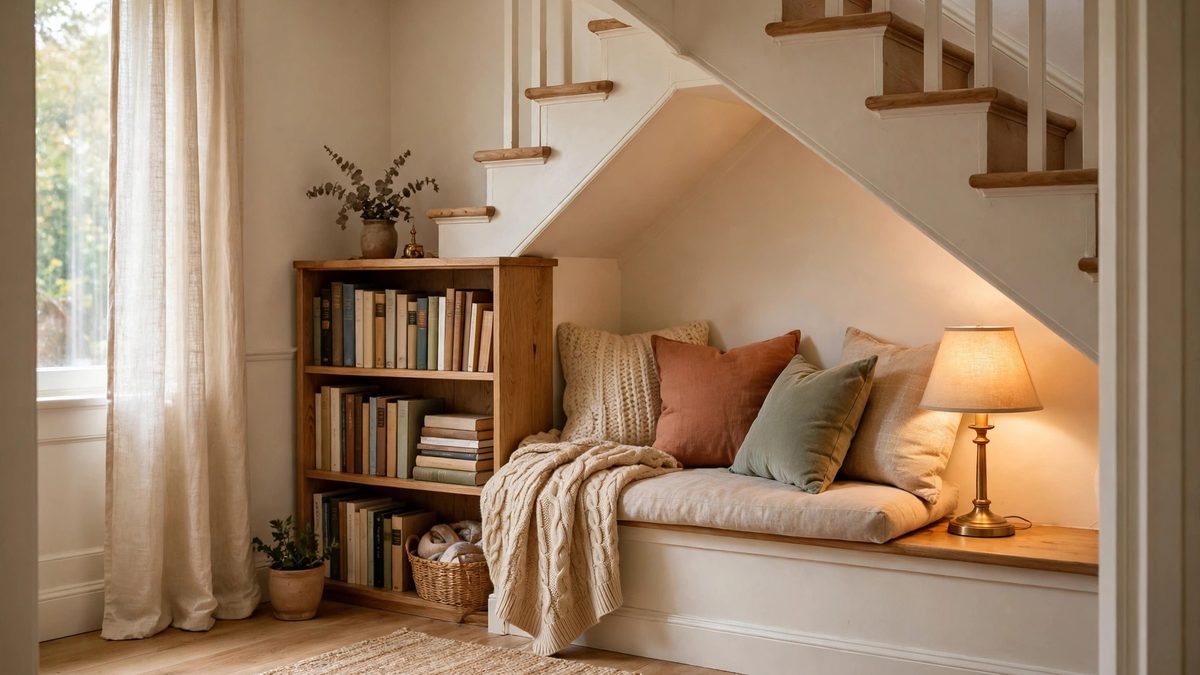
- Reading nook. A cushion, a small shelf, and a plug-in sconce turn the low triangle into the house’s most fought-over seat, especially for kids.
- Pet den. An open arch or gate-front nook with a washable bed gives dogs a den of their own and gets the crate out of the living room.
- Mini office or homework station. A desktop-height counter at the tall end, one shelf, and a task light create a genuine workstation in about 15 square feet.
Any use involving plumbing (a powder room) or sleeping needs permits and code checks — ceiling heights and ventilation rules apply — so treat those as renovation projects, not storage projects.
How to Organize Basement Overflow So It Stops Growing
The honest truth: the under-stair space stays tidy only if the basement stops absorbing everything else. Learning how to organize basement storage properly is the companion skill. Zone the basement the way stores zone warehouses: holiday decor together, tools together, archives and keepsakes together, each zone in labeled, same-size bins on shelving units — never cardboard on the floor, which wicks moisture.
Keep a “one in, one out” rule for the two overflow magnets, luggage and seasonal decor, and keep a clear path to the water heater, furnace, and electrical panel. A small walk in closet approach — the kind we detail in small walk in closet ideas — translates well downstairs: vertical shelving, a hanging section, and a strict floor-stays-clear policy. When the basement has zones, the under-stair closet can go back to holding the daily things it is best at: coats, shoes, the vacuum, and the flashlight you can find in the dark.
Mistakes to Avoid With Under-Stair Storage
- Building fixed storage over access points. Panels, valves, and cleanouts must stay reachable — use removable panels.
- Ignoring the slope in your measurements. The catalog photo’s closet system assumes a flat ceiling your space does not have.
- No light. A battery motion light inside the closet changes it from cave to cupboard.
- Deep, dark, single-bin storage. If you have to empty it to find anything, it is not storage, it is hiding.
- Skipping the door plan. Measure door swing against hallway traffic before choosing hinged, bifold, or drawer solutions.
Frequently Asked Questions
How much does built-in under stairs storage cost?
Simple shelving and bins can cost under a few hundred dollars in materials. Custom drawers and cabinetry typically run from around $1,000 to several thousand depending on size, materials, and your area — get local quotes for accuracy.
What is the best use for the low, sloped part of the space?
Drawers, pull-out bins, a pet den, or a kids’ reading nook — anything low and accessed from the front rather than by walking in.
Can I put a bathroom under the stairs?
Sometimes, but it is a renovation, not a storage project: it needs plumbing, ventilation, and minimum ceiling heights that many stair voids cannot meet. Check local codes and get a plumber’s opinion first.
How do I light an under-stair closet?
A battery-powered motion-sensor LED strip or puck lights are the easy answer — no wiring, and they switch on when the door opens.
What should NOT be stored under the stairs?
Anything flammable like paint thinner and solvents in quantity, and anything that blocks access to electrical panels or plumbing shut-offs. Everyday household items are fine.
Conclusion
Under stairs storage ideas succeed when they respect the slope, keep access points reachable, and assign the space a specific job — drawers for the daily grab-and-go, a closet for coats and the vacuum, door racks for the little things, and zones in the basement for everything else. Measure carefully, build or buy to those numbers, and the deadest space in your house becomes the storage you use most.
