
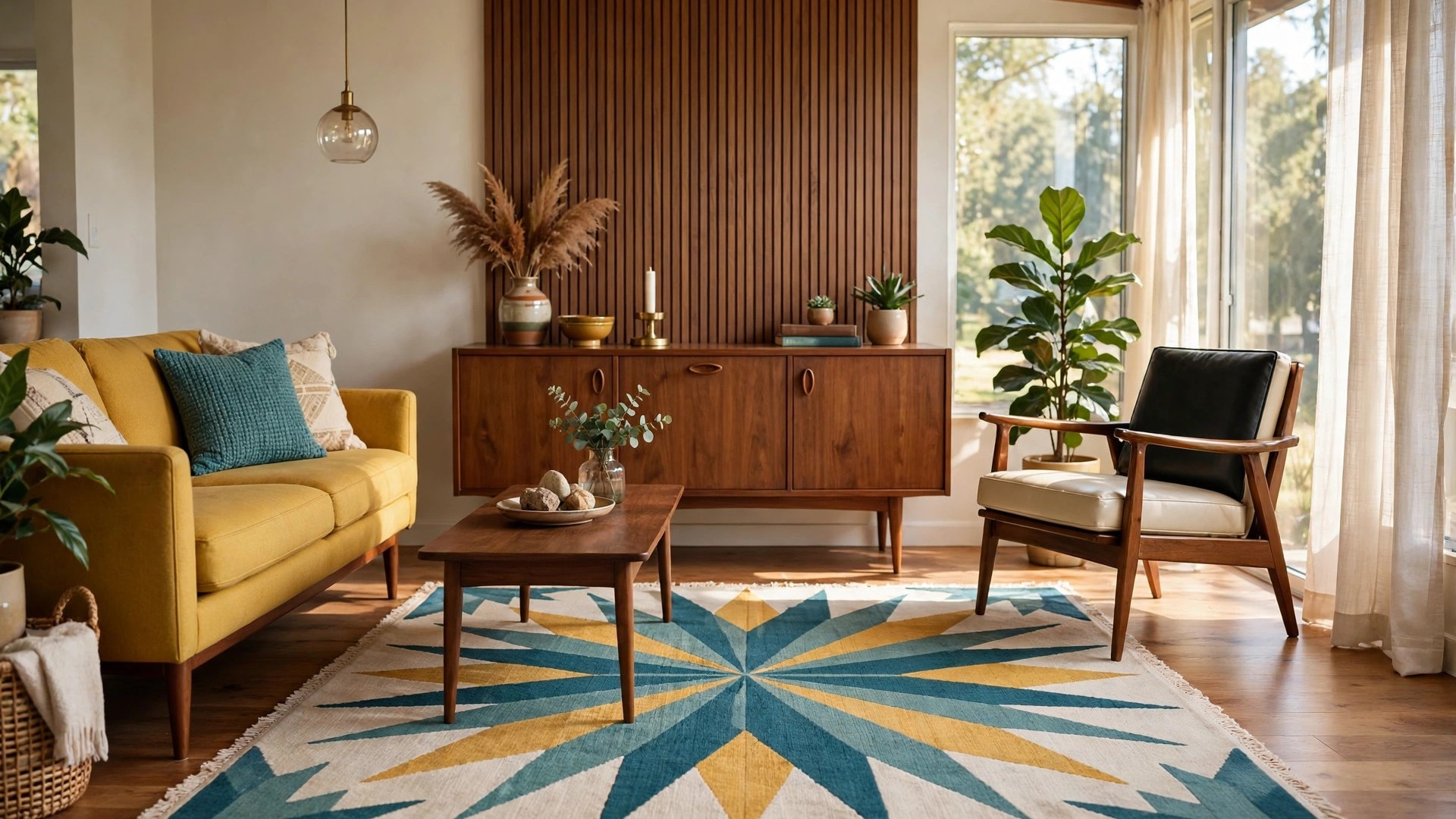

Few accessories change a room’s era as fast as the rug. Mid century modern rugs — with their starbursts, atomic boomerangs, bold geometry, and warm retro palettes — instantly give a living room or bedroom that collected, 1950s-to-60s character that pairs so well with today’s clean-lined furniture. The style is forgiving, too: one mid century rug can carry an otherwise plain room, and its patterns hide everyday wear better than most solids.
This guide breaks down what makes a rug read as mid century modern, the palettes that work with current furniture, and the sizes and materials to shop for. Whether your home is fully retro or you just want one confident vintage note, you will know how to choose a rug that looks intentional rather than theme-park.
What Makes a Rug Mid Century Modern?
Mid century modern design — roughly 1945 to 1969 — favored optimism, abstraction, and new materials. Rugs from and inspired by the era share a few fingerprints: flat or low pile rather than deep shag (though late-60s shag exists), graphic abstract patterns instead of traditional florals or medallions, and a palette built on warm neutrals punched up with saturated accent colors. Lines are confident: rays, orbs, kidney and boomerang shapes, irregular grids, and starbursts.
Authentic vintage pieces were often wool, sometimes hand-knotted or tufted in Scandinavia — the Swedish rya rug, with its long shaggy pile and abstract color blocks, is the era’s famous exception to the low-pile rule. Modern reproductions copy the graphics in wool, wool blends, or synthetics, which makes the look accessible at every budget. For the full design context, the Wikipedia overview of mid-century modern explains the movement these rugs came from — the same era that shaped the furniture they sit under.
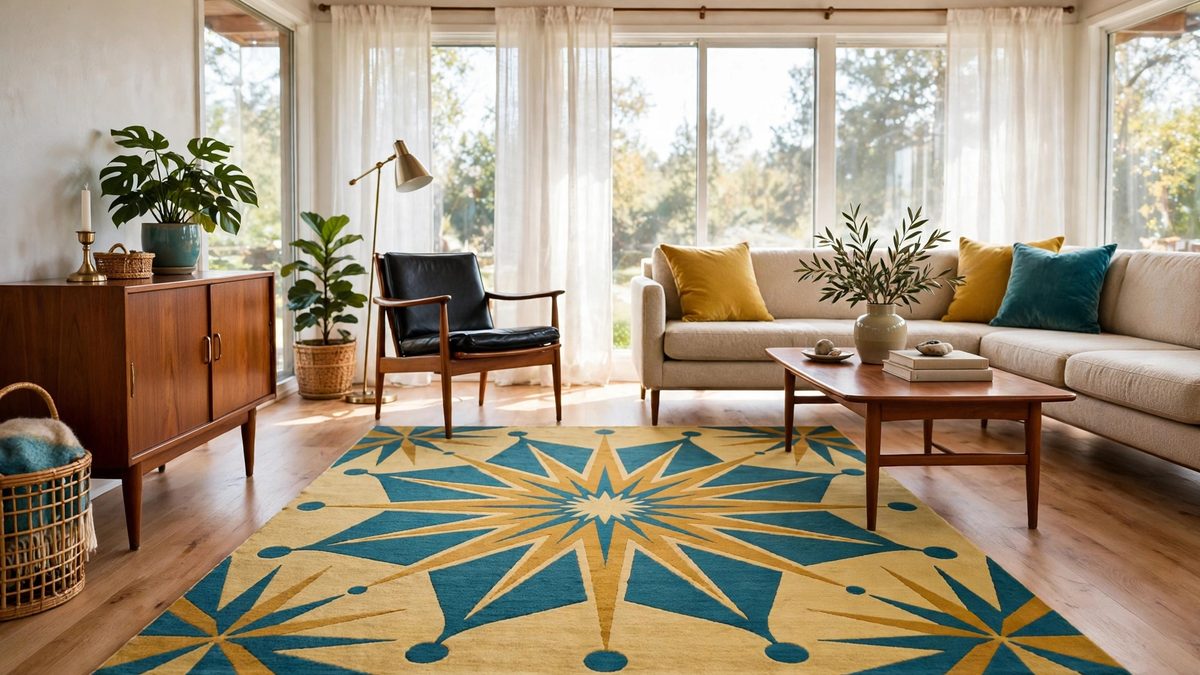
Iconic Patterns: Starbursts, Atomic Shapes, and Geometry
Pattern is the fastest route to the look. The greatest hits:
- Starburst and sunburst motifs. Radiating rays from a central point — the era’s signature, borrowed from atomic-age optimism.
- Atomic boomerangs and orbs. Scattered amoeba-like shapes and circles in contrasting colors on a neutral field.
- Bold geometry. Large-scale diamonds, chevrons, irregular rectangles, and color-blocked arcs; think abstract art laid flat.
- Scandinavian minimalism. Undyed wool tones, subtle stripes, and simple two-color grids — the quieter, Scandi side of mid century that suits calm rooms.
- Abstract “art rugs.” Painterly, asymmetric designs that function as the room’s artwork.
Scale matters: mid century patterns are usually medium-to-large in repeat. A small, busy print reads as generic retro; a big confident motif reads as design. If the room already has patterned upholstery or busy art, choose the quieter Scandi end of the spectrum so the rug grounds rather than competes.
The Classic Mid Century Color Palette
The palette is the second fingerprint. Build around warm, earthy neutrals — cream, oatmeal, warm gray, walnut brown — then add the era’s beloved accents:
- Mustard and gold — the most-used accent, warm against wood tones.
- Teal and aqua — cool counterpoints that love walnut and brass.
- Burnt orange and rust — autumnal and forgiving of wear.
- Avocado and olive green — softer than they sound, especially in wool.
- Charcoal and black — used as the graphic outline color in many atomic patterns.
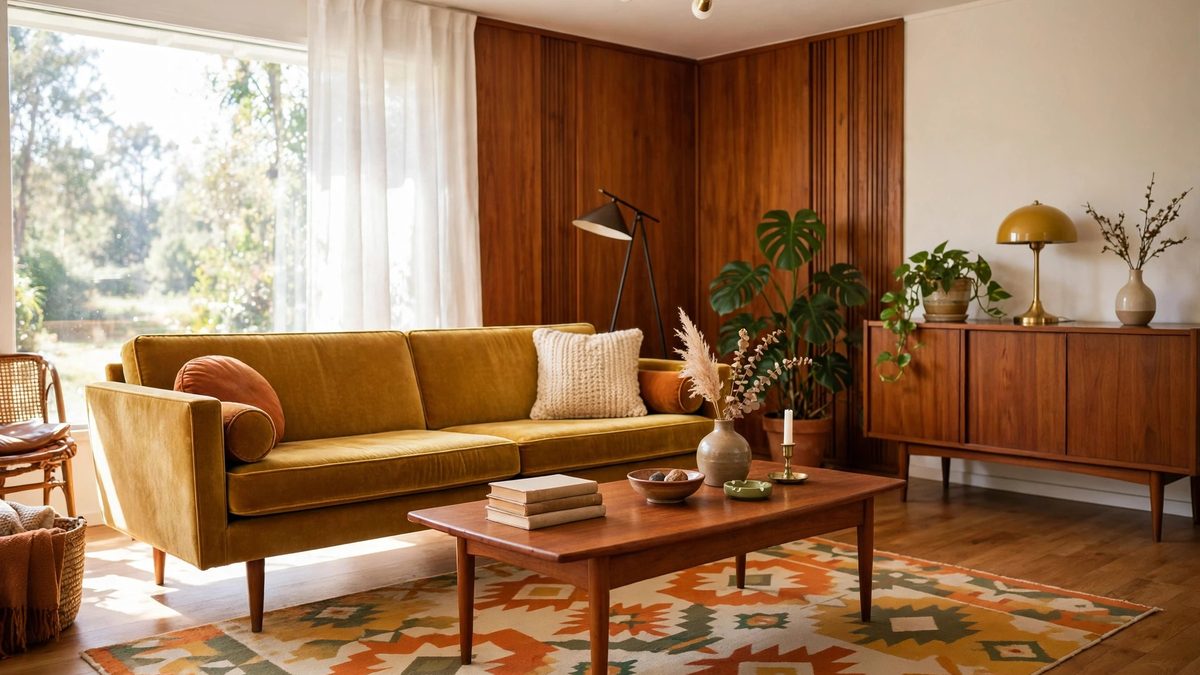
A reliable formula: no more than three colors in the rug, with one neutral doing most of the work. Pull one accent color from the rug into cushions or a lamp so the room looks connected. These palettes were designed to sit with warm woods, so if your room has honey oak floors or a walnut sideboard, you are already halfway there.
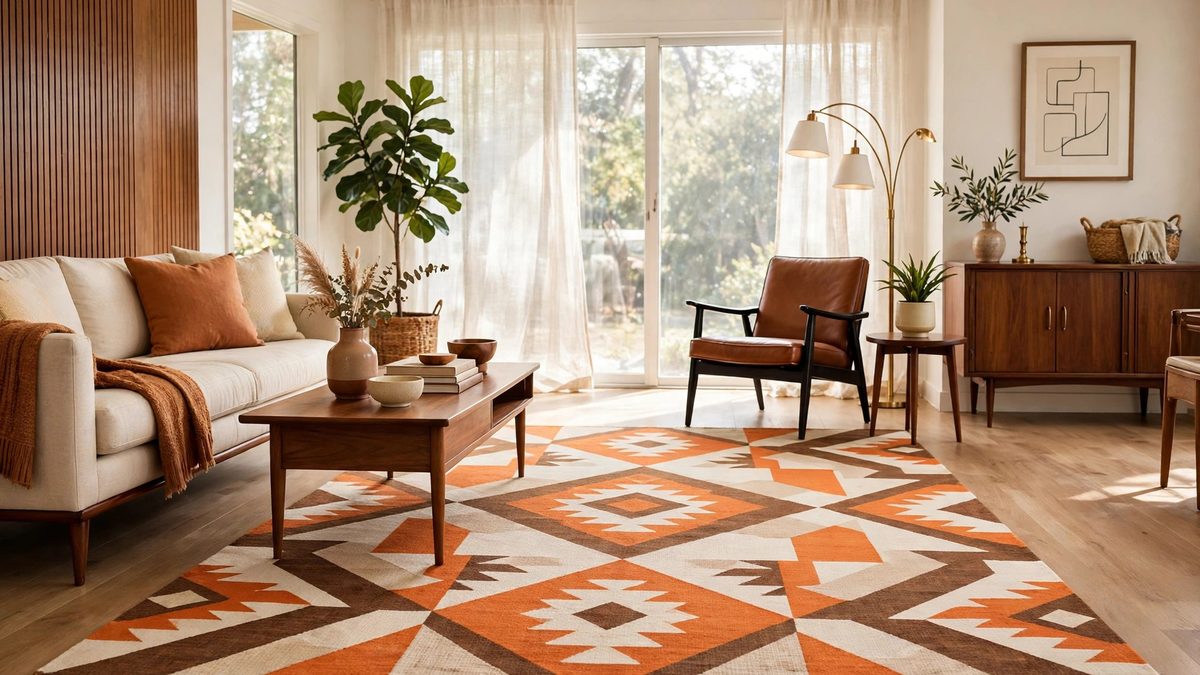
Choosing the Right Size and Placement
Mid century pattern needs room to show its repeat, which makes size doubly important. Standard sizes behave the same as with any rug — 5×8 feet for small seating areas, 8×10 for most living rooms, 9×12 for large rooms — with the front legs of sofas and chairs on the rug. Because the motif is the point, avoid cutting a starburst in half at the sofa’s edge if you can: shifting the rug a few inches so the main motif sits whole in front of the seating looks deliberate.
Under a dining table, choose a flatweave or low-pile mid century design big enough for chairs to stay on the rug when pulled out (add roughly 24 inches on all sides of the table). In bedrooms, an 8×10 under the lower two-thirds of a queen bed shows the pattern at the foot and sides where you see it. For a refresher on measuring, see our guide to standard rug sizes.
Materials: Wool, Flatweaves, and Modern Reproductions
Wool is the period-correct and still the best-performing choice: resilient, naturally stain-resistant, and it holds those saturated dyes beautifully. A wool mid century rug typically costs more but outlasts synthetics by years. Cotton flatweaves give the crisp graphic look at low prices and suit dining areas and kitchens, though they need a pad to stay put and feel thin underfoot. Synthetic reproductions (polypropylene and polyester) copy vintage designs at the lowest prices, clean easily, and work well in high-traffic or pet zones — the trade-off is a flatter texture and less depth of color.
One styling technique worth knowing: mid century rugs shine as the top layer in a stack, where a large neutral base gives the vintage pattern its stage. Our guide to layered rugs shows the base-and-top method and the border proportions that make it work.
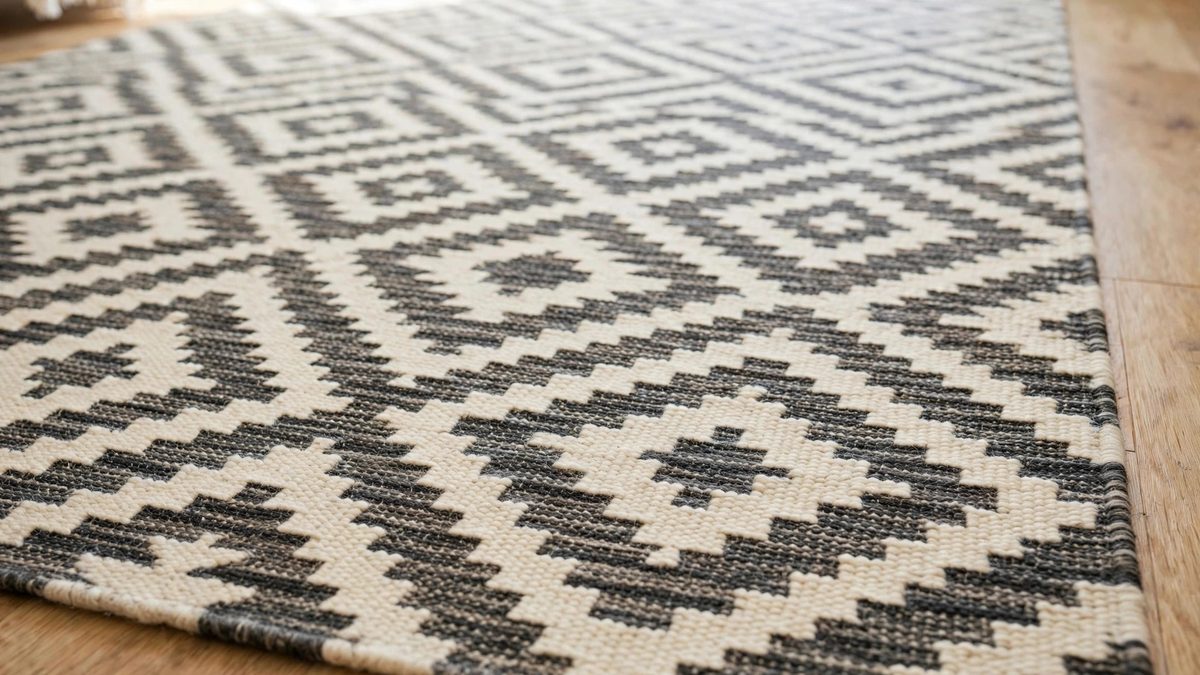
Styling Mid Century Rugs With Today’s Furniture
You do not need a full retro room. Mid century rugs mix happily with current pieces if you echo two or three era cues elsewhere: tapered wood legs on a chair or sideboard, a brass or globe lamp, one piece of walnut furniture. Keep the rest calm — solid upholstery in linen, boucle, or leather lets the rug’s pattern lead.
In a fully mid century room, the rug can go bolder and the furniture quieter in color but true in silhouette. Either way, mind the wood tones: the rug’s warm palette forgives mixing walnut, teak-look, and oak as long as the undertones stay warm.
Do not overlook runners. A mid century runner in a hallway or galley kitchen is a low-commitment way to test the palette before investing in a room-size piece — the standard runner sizes, about 2.5 feet wide by 8 or 10 feet long, suit most halls, and the long format shows off a starburst or stripe repeat beautifully.
Entryways are another easy win: a 3×5 or 4×6 atomic-pattern rug inside the front door sets the era in the first three seconds of the house and hides tracked-in dirt better than any solid. If you fall for the look in these small doses, scaling up to the living room later feels like a natural next step rather than a gamble. The same cross-era logic appears in our mid century modern bathroom ideas, where one era-correct element carries a whole small room.
Care Tips and Buying Mistakes to Avoid
Wool mid century rugs ask for the usual wool care: vacuum without a beater bar on delicate or vintage pieces, blot spills quickly, and rotate the rug twice a year so sun and traffic even out. Vintage rugs deserve a professional cleaning rather than a rental machine.
Mistakes to avoid:
- Pattern too small. Tiny retro prints read as noise; go bigger than feels safe.
- Ignoring the pad. Flatweaves and light wool rugs slide on hard floors without one.
- Cold palette clashes. Blue-grays and icy whites fight the era’s warmth; test the rug against your floor and sofa in daylight.
- Buying vintage without checking size. True vintage pieces come in non-standard sizes — measure your space first, then shop.
Frequently Asked Questions
What colors are in a typical mid century modern rug?
Warm neutrals like cream and oatmeal paired with mustard, teal, burnt orange, avocado green, and charcoal accents. Most designs use two or three colors total.
Are mid century modern rugs low pile?
Usually yes — flatweave or low pile suits the graphic patterns and the era’s furniture. The shaggy Scandinavian rya rug is the famous exception.
What size mid century rug works in a living room?
An 8×10-foot rug fits most living rooms, with front legs of seating on the rug; 9×12 suits large rooms and 5×8 suits small ones. Make sure the main motif sits whole where it shows.
Can I mix a mid century rug with modern furniture?
Absolutely — that is the most common way they are used. Echo the era with one or two wood or brass pieces and keep upholstery solid so the rug leads.
Are vintage mid century rugs better than reproductions?
Vintage wool pieces have unmatched character and durability but come in odd sizes and higher prices. Good modern reproductions deliver the look with standard sizes and easier care.
Conclusion
Mid century modern rugs earn their popularity honestly: bold but disciplined patterns, a warm and forgiving palette, and low-pile practicality that suits real life. Choose a confident motif at the right scale, anchor it in standard sizes, let wool do its durable work if the budget allows, and echo the era once or twice elsewhere in the room. The result is a floor that looks collected, not decorated — and a room that feels like it has a point of view.
