
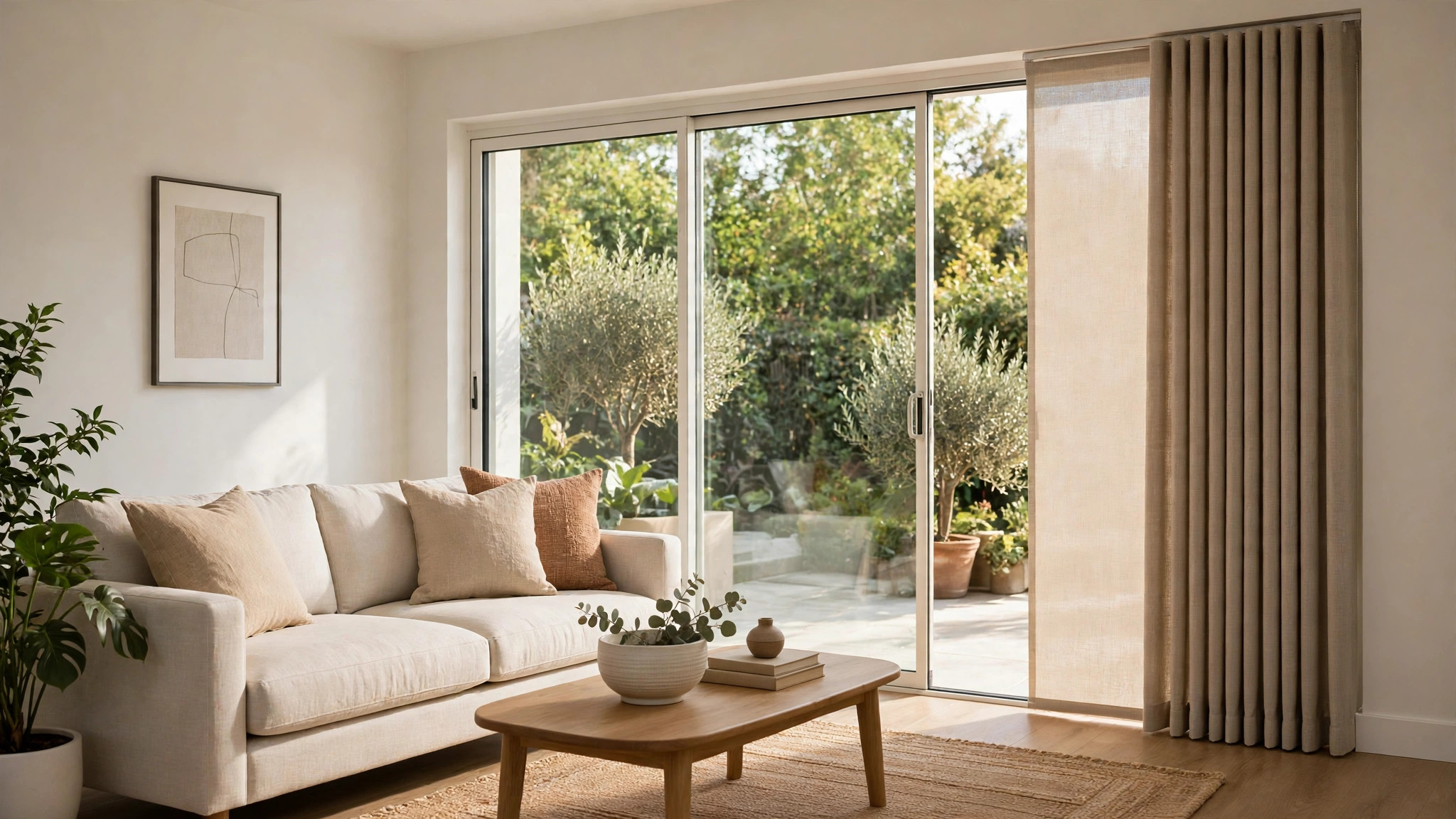

A sliding glass door is really a moving wall of glass, and it defeats most standard window coverings. Horizontal blinds crash into the handle, curtains billow every time the door opens, and anything that lifts straight up is a daily annoyance on a door you use twenty times a day. The right blinds for sliding doors share one trait: they travel sideways, the same direction the door does.
This guide compares the options that actually work, vertical blinds, panel tracks, sliding shades, and drapery, then covers French doors, oversized windows, and bay windows, which all borrow from the same playbook. It ends with the measuring rules that prevent expensive mistakes.
Start With Size: Standard Sliding Doors and How to Measure
Most residential sliding patio doors come in a few standard sizes: about 5, 6, or 8 feet wide and 80 inches tall, with wider custom sliders running 12 feet or more. Because the covering must clear the door frame and the floor, sliding door treatments are almost always outside mounted, attached to the wall or trim above the door rather than inside the frame.
Measure the full area you want covered, not just the glass. Most guides suggest letting the treatment overlap the opening by roughly 3 to 4 inches at the top and on the sides for better light block and privacy, and finishing about 1/2 inch above the floor or sill so the vanes or panels glide freely. Decide the stack side early: the covering will bunch on one side (or split in the middle), and it should stack over the fixed panel, not the one you walk through.
Also note the door handle. It projects into the room and can catch on treatments that hang close to the glass, so check the depth of your chosen covering against the handle before ordering. The comparison guides at SelectBlinds walk through these measurements style by style.
Blinds for Doors That Move Sideways
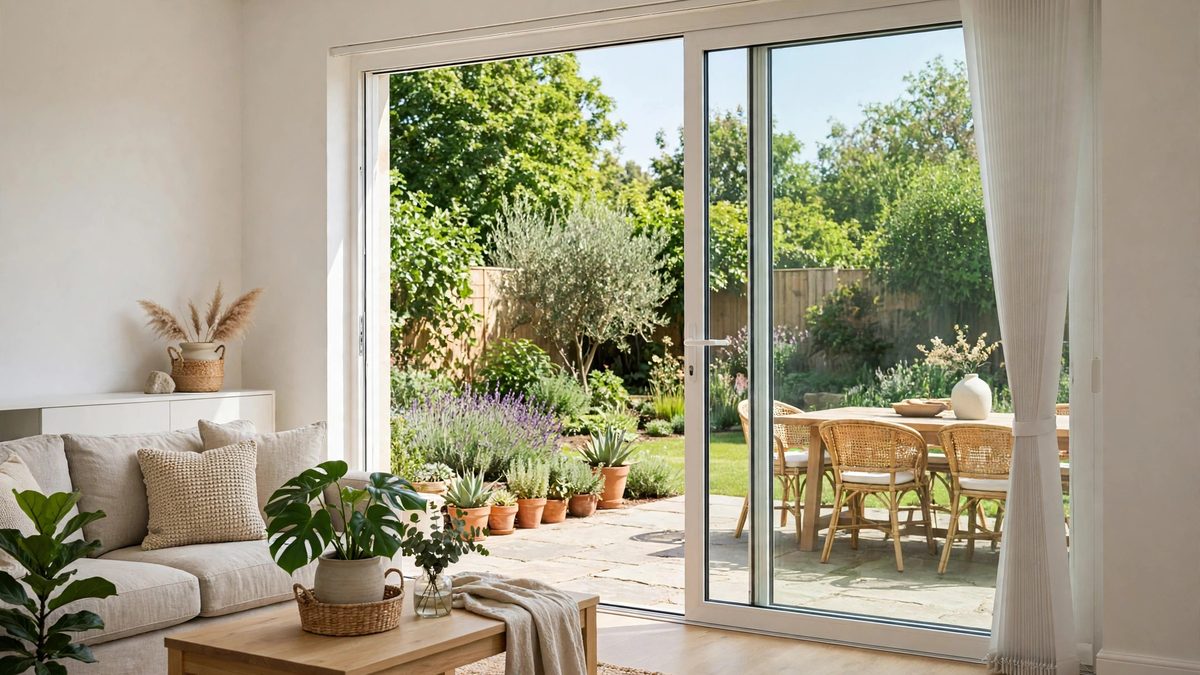
The classic answer, and still the best-selling one, is the vertical blind. Long vanes, usually about 3.5 inches wide, hang from a headrail, tilt for light control, and traverse to one side when you need the door. Fabric vanes soften the look, vinyl vanes wipe clean in seconds, and S-curve vanes close more tightly for better privacy. Verticals are also among the most budget-friendly coverings per square foot of glass, which matters on an 8-foot door.
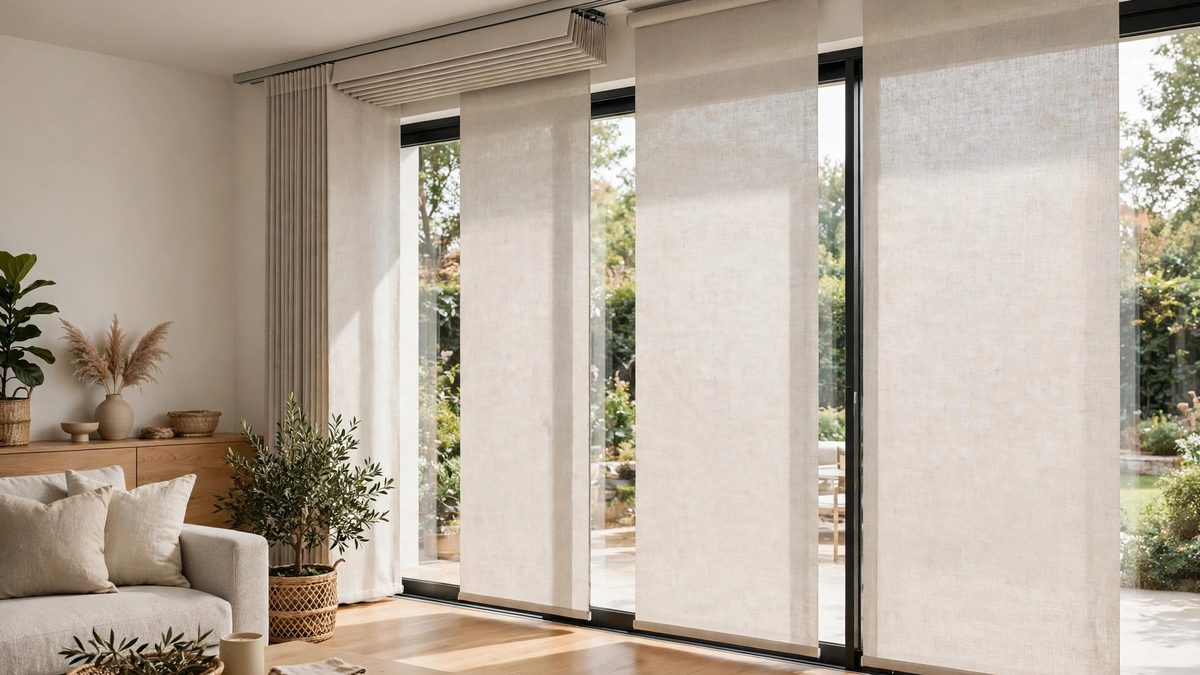
Panel track blinds are the modern alternative. Instead of narrow vanes, wide fabric panels, often 20 to 30 inches across, glide along a track and stack neatly. Closed, they read like a clean textile wall; open, they compress to one side. They suit contemporary rooms and very wide doors better than verticals, though their light control is mostly all-or-nothing since the panels do not tilt.
Whichever you choose, wand or cordless operation keeps things safest and simplest, especially in homes with kids and pets. If your slider opens from the center, a split-stack configuration that gathers at both ends keeps the walkway completely clear.
Shades for Sliding Glass Doors That Slide With You
If you prefer the softness of a shade, look for versions engineered to move horizontally. Shades for sliding glass doors include vertical cellular shades, whose honeycomb fabric travels sideways on a rail and stacks into a surprisingly slim bundle. The cellular construction insulates that big sheet of glass, which is the leakiest thermal spot in many rooms.
Sliding panel systems sold as shades, sometimes called panel track shades, use the same wide-panel idea in shade fabrics, including solar fabrics that cut glare while keeping the view. Sheer vertical wraps, which drape a soft fabric over a vertical blind mechanism, are another hybrid worth knowing about: they look like flowing curtains but operate like blinds.
Traditional horizontal shades can technically be mounted over a slider, but you will raise the whole shade every time you step outside, and the raised stack blocks part of the glass. For a door used daily, side-to-side shades are simply easier to live with, a point worth weighing against their slightly higher price.
The Best Window Treatment for French Doors
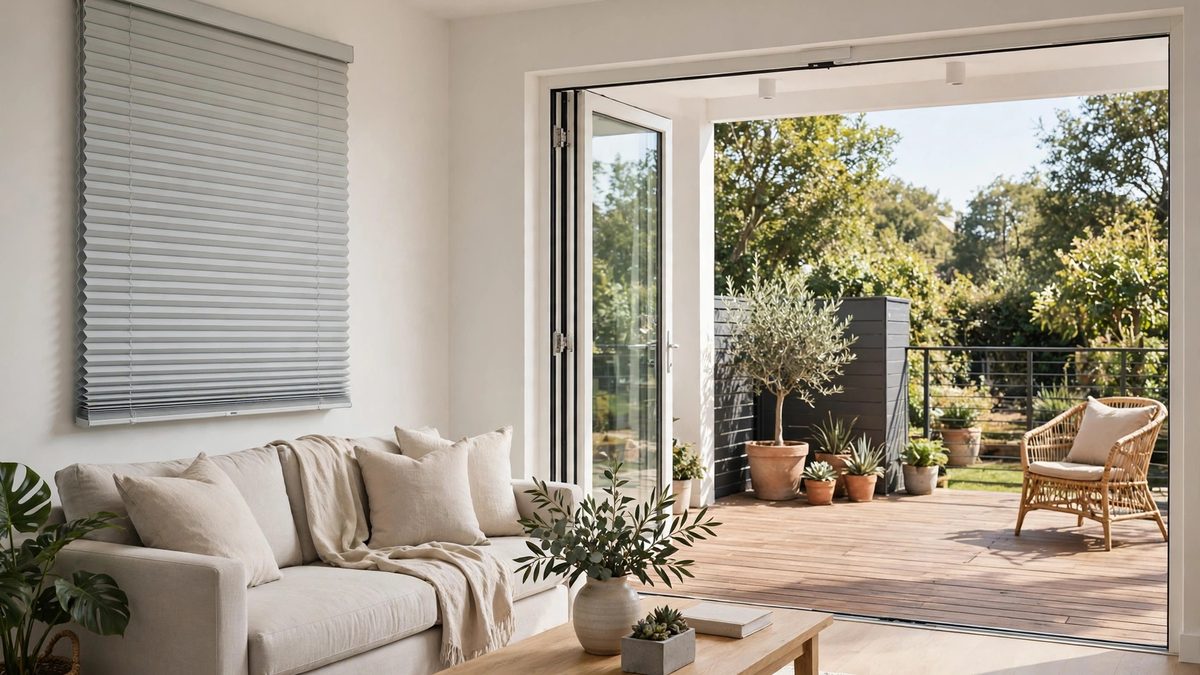
French doors ask for something different: a window treatment for French doors usually mounts directly on each door so it moves with the door as it swings. Slim blinds and shades in a shallow profile are the standard picks: 1-inch mini blinds, slim cellular shades, and compact roller shades all fit behind most lever handles, though you should measure the gap between the glass and the handle before ordering.
Hold-down brackets at the bottom keep the treatment from swinging and clattering every time the door opens. If you are replacing the doors themselves, blinds-between-the-glass units seal the blinds inside the glass panes, which means no dusting, no cords, and nothing to catch, at a higher upfront cost.
Curtains can work on French doors too, hung on a rod above the frame, but they must clear the swing of both doors. Many people prefer the tailored look of door-mounted shades; if you are still deciding between fabric and slats generally, our explainer on what is a window treatment lays out the families side by side.
Window Coverings for Large Windows Beyond the Door
Everything that works on a slider applies, with even more force, to window coverings for large windows such as two-story great room glass and wide picture windows. Panel tracks and vertical blinds cover big spans in a single unit, while wide windows often look best treated as one composition rather than a row of separate small blinds with gaps between them.
Height brings its own problem: controls. On tall glass, motorization stops being a luxury and becomes the practical way to actually use the covering every day. Solar fabrics earn their keep here too, taming glare on the upper glass while preserving the view that made you want big windows in the first place. Drapery is the other large-window classic, and if you lean that way, our living room drapes and curtains ideas cover fabrics and hanging heights.

Bay Window Treatments That Respect the Angles
A bay window is three or more window sections joined at angles, commonly 30 or 45 degrees, and bay window treatments must handle those corners gracefully. The two proven approaches are treating each section individually, with matching blinds or shades on each pane, or running one continuous treatment, such as a custom curtain rod bent to follow the bay, across the whole shape.
Individual treatments give each section its own light control and a tailored look, but the hardware in the corners needs careful measuring so adjacent headrails do not collide. Continuous drapery softens the geometry and is forgiving of odd angles. Either way, keep the fabrics and colors identical across sections so the bay reads as one feature, and avoid treatments so deep that they swallow the window seat, if you have one. The same per-section logic applies to the headers and pleats described in our guide to types of curtains.
Mistakes to Avoid on Glass Doors
- Choosing a covering that fights the door’s direction. If it does not move sideways, you will wrestle it daily.
- Measuring only the glass. Under-measured treatments leak light and privacy at every edge. Overlap the frame generously.
- Ignoring the handle and stack. Know where panels pile up and whether the handle clears the covering before you buy.
- Hanging panels that drag the floor. Treatments should finish just above the floor so they glide and stay clean.
- Long cords near a busy doorway. Choose wand, cordless, or motorized operation for safety and convenience.
Frequently Asked Questions
What are the best blinds for a sliding door used every day?
Vertical blinds and panel track blinds are the most practical, because they slide sideways and stack clear of the walkway. Vertical cellular shades are the best pick when insulation matters most. All three avoid the lift-and-lower routine of horizontal coverings.
How wide should blinds be for a 6-foot sliding door?
A standard 6-foot (72-inch) slider is 80 inches tall. Order the covering wide enough to overlap the frame, typically a few inches beyond the opening on each side, so a finished width around 76 to 80 inches is common. Always follow the manufacturer’s measuring guide for the exact product.
Can I put curtains over a sliding glass door?
Yes, if the rod is mounted high and wide enough that the panels stack mostly over the wall and the fixed panel, and the fabric clears the floor. One-way draw curtains that stack on the side opposite the operating door are the most convenient arrangement.
Do vertical blinds still look modern?
They can. Choose fabric or S-curve vanes in a soft neutral, skip the valance for a cleaner headrail, and the result reads tailored rather than office-like. Panel tracks are the more contemporary alternative if you want wide, flat planes of fabric instead.
How do I keep sliding door blinds clean?
Vinyl vanes wipe down in place with a damp cloth. Fabric vanes and panels vacuum with a brush attachment. Working top to bottom, a few minutes twice a year keeps most sliding door treatments looking new.
Conclusion
The rule for glass doors is simple: the covering should move the way the door moves. Vertical blinds remain the budget-friendly classic, panel tracks bring the modern look, and vertical cellular shades add real insulation to a wall of glass. Measure wide, plan the stack side, respect the handle, and the same ideas will carry you through French doors, big windows, and bays. Get those basics right and your sliding door becomes easy to live with at every hour, bright, private, and draft-free.
